




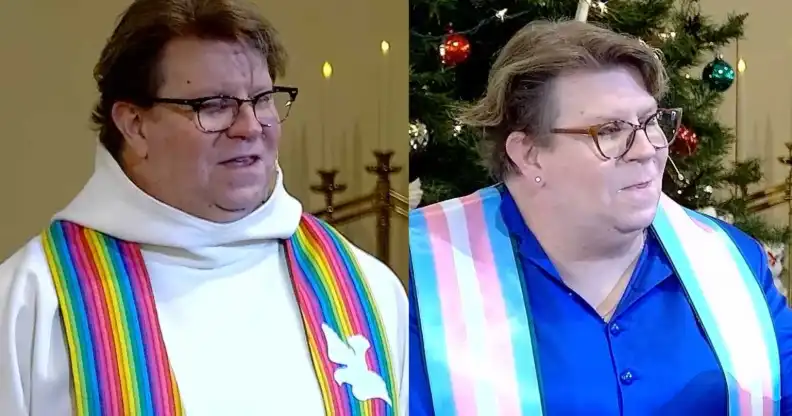
A Methodist pastor in the United States publicly came out as transgender during a deeply personal sermon, telling her congregation, “The best way to put this is that I’m not becoming a woman, I’m giving up pretending to be a man.”
Pastor Phillippa Phaneuf, who leads North Chili United Methodist Church in Rochester, New York, used the closing portion of the November 23 worship service to explain what her transition will mean for her role and her church community.
“I am inviting you to join me in a season of creative transformation for myself,” she said, “and, I think, for all of us.”
Phaneuf noted that she is not undertaking this journey alone, stressing that her denomination, district superintendent, bishop, and even scripture offer her affirmation.
“Did you know that there are eight different Hebrew words for different gender types?” she asked the congregation, adding, “In the ancient Hebrew they recognized at least eight different gender types.”
She described the profound sense of well-being she has felt since starting hormone replacement therapy three months earlier, saying the positive change could not be at odds with God’s intentions.
“Imagine if your doctor came and told you that your quality and outlook on life could transform exponentially to the positive. Would you listen to that doctor? If you felt God’s Holy Spirit surrounding you in ways that you haven’t felt in years, would you have a sense that that might be something that God was okay with?”
While acknowledging that the news might be surprising or unsettling for some, Phaneuf urged her congregation to approach the moment with openness.
“Because really what it comes down to is awareness. So let’s just be aware and recognize the fact that there can often be, in these kinds of situations, the fear of the unknown.”
She went on to outline what aspects of her life and ministry would shift and which would remain unchanged. Although her appearance, voice, wardrobe, and pronouns will evolve, she assured church members:
“What will stay the same,” she said, “is my commitment to the good news of Jesus Christ, our togetherness in ministry, (unfortunately for all of you) my personality, my style of teaching, my style of preaching, my adhd brain type (you’re welcome), my sense of humor – none of that is changing.”
Phaneuf also suggested that her transition could further strengthen the church’s sense of welcome, positioning it as “an even safer space for people who have felt marginalized.”
“Notice what I said, an even safer space. I didn’t say that we’ll become that, because I wouldn’t be able to do what I’m doing now unless I had felt the love and support from all of you.”
However, she acknowledged that not everyone in her life has been able to accept her choices. Phaneuf shared that her parents “were absolutely not” supportive and had asked her to read a message to the congregation: “They texted me this morning, and they asked for me to tell you all that they do not support me, and that they have chosen their convictions and their beliefs over supporting their child.”
Even so, she expressed belief that any congregants who feel unsure will come to understand as they see her living more fully.
“That’s what we want for the people in our lives, isn’t it?” she asked.
Phaneuf also pointed to the United Methodist Church’s landmark 2024 General Conference decision to overturn its longstanding prohibition on LGBTQ+ clergy. Delegates voted 692–51 to lift the restriction, while also approving a measure preventing penalties for pastors who choose either to perform or decline to perform same-sex weddings.
The denomination’s shift toward LGBTQ+ affirmation has prompted significant departures from congregations that disagreed with the new direction. In 2019, the UMC authorized churches to disaffiliate through the end of 2023 over objections related to changes involving homosexuality and same-sex marriage.
According to the United Methodist News Service, 7,286 churches—more than 20 percent of U.S. congregations—have been approved for disaffiliation since 2019, with more than 5,000 leaving in 2023 alone.