





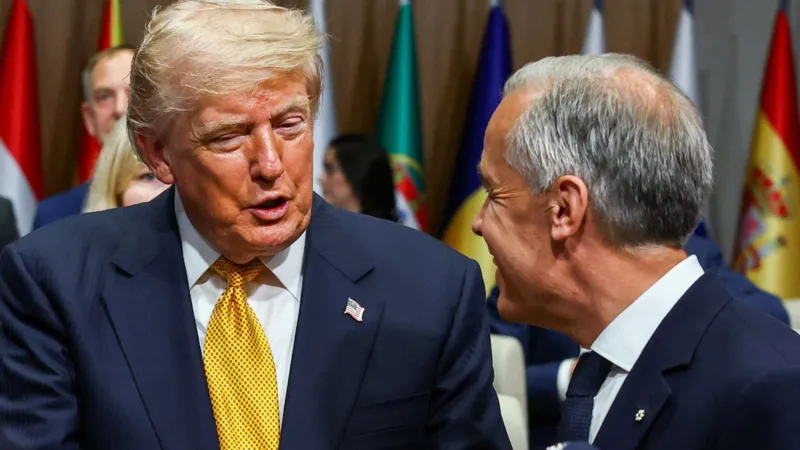
United States President Donald Trump has announced a 50% tariff on a wide range of goods imported from Canada. This sharply escalates the trade dispute between the two neighbouring countries.
According to BBC, the new duties target consumer products such as Canadian wine and hockey sticks. Industrial goods including cement are also targeted.
However, the tariffs will not apply to some of Canada’s most important exports. This includes energy products, potash, fish and critical minerals.
The White House said the duties would take effect 30 days after Trump signed three proclamations authorising the new trade measures.
Canadian Prime Minister Mark Carney responded by saying his government was ready to “intensify” negotiations with Washington. This would happen in the coming weeks.
Tariffs override USMCA protections
The White House said the new duties would apply to all covered Canadian products. This includes those that previously qualified for preferential treatment under the United States-Mexico-Canada Agreement.
Trump accused Canada of giving American cars, dairy products and alcoholic beverages unequal treatment in its domestic market.
The US president argued that Canadian trade practices unfairly restricted American companies while giving other foreign competitors more favourable access.
Carney rejected Washington’s position and accused the United States of violating the regional trade agreement.
“This is the latest in a series of unilateral US trade actions that began with the US imposing a series of tariffs in direct violation of the Canada-United States-Mexico Agreement,” Carney said in a statement.
The Canadian leader also referred to “threats to Canadian sovereignty,” amid Trump’s repeated remarks about making Canada the 51st state of the United States.
Long-running disputes fuel escalation
The new tariffs add to several trade barriers already imposed by both countries.
Washington currently applies duties ranging from 15% to 50% on some Canadian steel, aluminium and copper products.
The United States also charges a 35% tariff on Canadian softwood lumber. In addition, it charges a 25% duty on non-US components in imported vehicles.
Canada has responded with 25% counter-tariffs on selected American steel, aluminium and vehicle imports.
The two countries have also disagreed over Canada’s tax treatment of American vehicles and components. These do not qualify for protection under the USMCA.
Trump described the Canadian policy as discriminatory. He argued that Ottawa does not impose a similar tax on vehicles from certain other countries.
The disagreement threatens the highly integrated North American automotive sector. In this sector, manufacturers regularly move vehicles and components between factories in Canada, the United States and Mexico.
US Commerce Secretary Howard Lutnick previously argued that Canada should “come second” to the United States in automotive manufacturing.
Dairy and alcohol remain key issues
Canada’s dairy supply-management system has also remained a major source of tension.
The system limits foreign dairy imports, while products entering the country above established quotas can face tariffs exceeding 300%.
US officials argue that the policy prevents American farmers and dairy companies from competing fairly in the Canadian market.
Meanwhile, several Canadian provinces have continued boycotting American alcoholic beverages in response to earlier US tariffs.
Provincial authorities removed US products from shelves as trade tensions intensified between both countries.
Canadian premiers have said they would lift the boycott when Washington removes tariffs affecting important Canadian industries. These industries include metals and automobiles.
However, the White House cited the alcohol restrictions as one of the reasons for imposing the latest duties.
Carney seeks fresh negotiations
Canadian trade officials have spent months attempting to secure an agreement. This agreement would reduce some of the US tariffs already affecting the country’s exporters.
However, the latest announcement suggests that negotiations have suffered a significant setback.
Earlier in 2026, the United States declined to renew the USMCA in its existing form. In contrast, Canada and Mexico supported its continuation.
The agreement will remain in place on a rolling basis. Annual reviews are expected as the three countries negotiate possible changes.
Carney said Canada would continue defending its workers and businesses while pursuing negotiations with the United States.
Business groups urge resolution
Canadian and American business groups warned that the tariffs could increase costs and provoke further retaliation.
Candace Laing, President and Chief Executive Officer of the Canadian Chamber of Commerce, described the tariffs as a “regrettable decision.”
She urged officials from both countries to use the 30-day period before implementation to make meaningful progress in negotiations.
Chris Swonger, who heads the Distilled Spirits Council of the United States, also called for a negotiated solution.
He warned that the new tariffs could trigger additional Canadian retaliation. This could further harm businesses on both sides of the border.
The latest duties were introduced under Section 338 of the Tariff Act of 1930. This allows the US government to respond to alleged discrimination against American trade.
Trump turned to the provision after the US Supreme Court struck down wider tariffs. These wider tariffs had been introduced under emergency economic powers.
The court ruled that he exceeded his authority by relying on a law intended for national emergencies.
The latest action marks one of the most serious escalations in US-Canada trade relations. It leaves both governments with 30 days to seek an agreement before the tariffs take effect.