


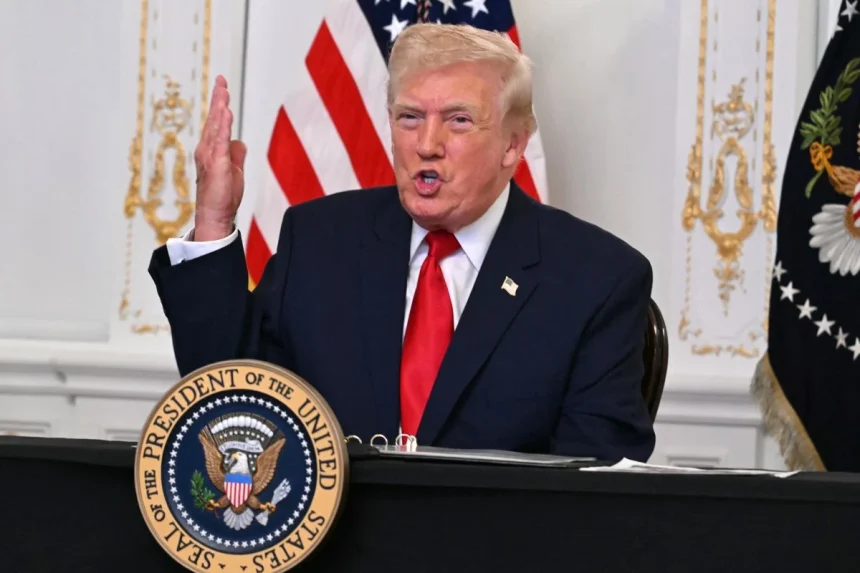
United States President, Donald Trump, reacted angrily on Friday after the Supreme Court of the United States ruled that he does not have unilateral authority to impose tariffs on imports, criticizing individual justices and pledging to press ahead with his global trade agenda that has unsettled markets for the past year.
Describing the decision as “ridiculous” and insisting he remained undeterred, Trump immediately unveiled a fresh 10% tariff on goods imported from all countries, in addition to existing duties, and signed a proclamation to enact the measure.
The law permits a levy of up to 15% for 150 days, though legal objections may follow.
The court’s 6-3 decision significantly altered the negotiating position Trump and his trade representatives have used in talks with foreign governments aimed at reshaping trade relationships and global commerce.
Following the ruling, U.S. stock markets initially rallied before closing only slightly higher, as analysts cautioned that investors were bracing for further uncertainty pending Trump’s next steps.
Later in the day, Trump signed an executive order rescinding the tariffs invalidated by the court. He also issued a proclamation introducing a 10% tariff on most imports for 150 days, with exemptions for select goods such as critical minerals, metals and energy products, according to the White House.
The judgment cast doubt on trade agreements negotiated in recent months under the threat of steep tariffs. It also left unresolved the status of the $175 billion collected from U.S. importers under the administration’s interpretation of the law, which the court found to be flawed.
“I’m ashamed of certain members of the court, absolutely ashamed, for not having the courage to do what’s right for our country,” Trump told reporters at the White House, complaining that foreign countries were ecstatic and “dancing in the street.”
He further alleged, without presenting evidence, that the court’s majority had yielded to outside pressure.
“They’re very unpatriotic and disloyal to our Constitution. It’s my opinion that the court has been swayed by foreign interests and a political movement that is far smaller than people would ever think.”
Since returning to office 13 months ago, Trump has maintained that he possessed what the court described as “extraordinary power to unilaterally impose tariffs of unlimited amount, duration, and scope.” Invoking a national emergency, he argued that the International Emergency Economic Powers Act granted him authority to set tariffs at his discretion.
The court’s opinion, authored by Chief Justice John Roberts, cited the U.S. Constitution: “The Congress shall have Power To lay and collect Taxes, Duties, Imposts and Excises.”
The administration’s claim that a war-like emergency justified bypassing Congress did not persuade the justices.
“The Government thus concedes, as it must, that the President enjoys no inherent authority to impose tariffs during peacetime,” Roberts wrote.
“And it does not defend the challenged tariffs as an exercise of the President’s warmaking powers. The United States, after all, is not at war with every nation in the world.”
Despite the court’s firm language, Trump signaled alternative measures were available.
“It’s ridiculous, but it’s OK, because we have other ways, numerous other ways,” he told reporters.
After a year marked by frequent tariff announcements that have jolted markets and complicated global trade, the ruling and Trump’s swift response reintroduced uncertainty that many economists and policymakers had hoped had subsided.
“I think it will just bring in a new period of high uncertainty in world trade, as everybody tries to figure out what the U.S. tariff policy will be going forward,” said Varg Folkman, an analyst at the European Policy Centre think tank.
U.S. Treasury Secretary Scott Bessent said the decision could have mixed implications.
“The Supreme Court has taken away the President’s leverage, but in a way, they have made the leverage that he has more draconian because they agreed he does have the right to a full embargo,” Bessent told “The Will Cain Show” on Fox News.
“We will get back to the same tariff level for the countries. It will just be in a less direct and slightly more convoluted manner,” he said.
In rolling out the temporary 10% tariff, Trump invoked Section 122 of the Trade Act of 1974, becoming the first U.S. president to use the provision, which allows tariffs of up to 15% for 150 days to address “fundamental international payments problems.”
Any extension beyond that period would require congressional approval and could face further legal scrutiny.


