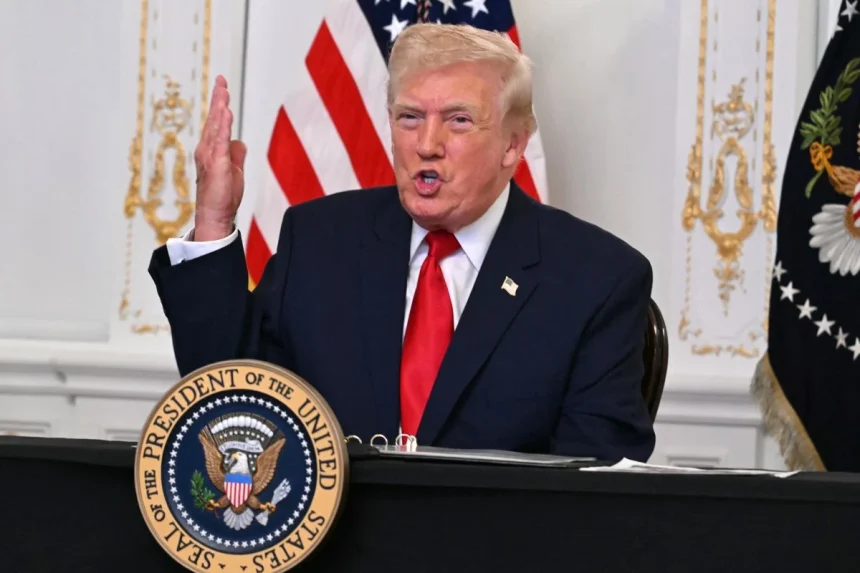
At 18:32 Washington time, Donald Trump announced on his social media platform that the United States and Iran were “very far along” in reaching what he described as a “definitive” peace agreement.
He revealed that a two-week ceasefire had been agreed upon to allow negotiations to move forward.
The development came just ahead of his self-imposed 20:00 EDT (00:00 GMT Wednesday) deadline, after which the US had threatened sweeping strikes on Iranian energy and transport infrastructure if no agreement was reached.
The arrangement hinges on Iran halting hostilities and reopening the Strait of Hormuz to global commercial shipping. Iranian authorities have indicated compliance, though they maintain they retain “dominion” over the vital passage.
The agreement offers Trump a way out of a difficult decision that had been rapidly approaching—either escalating military action, following his warning that a “whole civilisation will die tonight,” or stepping back and risking damage to his credibility.
However, the ceasefire is widely viewed as temporary, with uncertainty still looming.
Talks between US and Iranian officials are expected to continue over the next two weeks in an effort to secure a lasting resolution. While the path ahead may prove challenging, financial markets reacted positively. Oil prices fell below $100 per barrel for the first time in days during after-hours trading, and US stock futures surged, reflecting cautious optimism.
Just a day earlier, Trump had issued a stark warning threatening the destruction of Iranian civilisation “never to be brought back again.” Whether such rhetoric played a role in pushing Iran toward the ceasefire remains unclear, but the language marked a sharp departure from traditional presidential tone.
Even if negotiations ultimately succeed, analysts suggest the conflict—and Trump’s rhetoric—may leave a lasting impact on global perceptions of the United States. A country long seen as a stabilizing force is now being viewed by some as contributing to geopolitical instability, while Trump’s approach to international affairs mirrors his norm-breaking domestic style.
Democratic leaders swiftly condemned the president’s remarks. Congressman Joaquin Castro wrote on X, “It is clear that the president has continued to decline and is not fit to lead.” Senate Democratic leader Chuck Schumer warned that any Republican who failed to support ending the conflict “owns every consequence of whatever the hell this is.”
While many Republicans continued to back the president, dissent emerged within the party. Congressman Austin Scott criticized Trump’s rhetoric, saying, “The president’s comments are counter-productive,” and adding, “I do not agree with them.” Senator Ron Johnson cautioned that carrying out the proposed bombing campaign would be a “huge mistake.”
Similarly, Congressman Nathaniel Moran rejected the notion of destroying a civilisation, writing, “This is not who we are,” and asserting that such actions contradict longstanding American principles. Senator Lisa Murkowski also voiced concern, stating that the president’s threat “cannot be excused away as an attempt to gain leverage in negotiations with Iran.”
The White House is expected to argue that the strategy yielded results, pointing to the ceasefire as evidence of effective pressure. For Trump, who has faced slipping approval ratings, criticism within his party, and economic strain driven by rising energy costs, the pause in hostilities offers some relief.
In his ceasefire announcement, Trump claimed the US had “met and exceeded” its military goals. Iran’s military capabilities have reportedly been weakened, and several senior leaders killed in airstrikes, though its governing structure remains intact.
Nevertheless, key US objectives remain unresolved. The status of Iran’s enriched uranium stockpile—central to its nuclear ambitions—remains uncertain. Additionally, Iran continues to exert influence through regional allies, including the Houthi movement in Yemen.
Even if Iran fully reopens the Strait of Hormuz without imposing tolls or restrictions, its demonstrated ability to influence one of the world’s most critical shipping routes has become increasingly evident.
Following Trump’s announcement, Iranian Foreign Minister Seyed Abbas Araghchi confirmed that Iran would suspend its “defensive operations” and permit safe passage through Hormuz “via coordination with Iran’s armed forces.” He also stated that the US had accepted the “general framework” of Iran’s proposed 10-point plan.
That proposal includes demands such as a US military withdrawal from the region, the lifting of economic sanctions, compensation for war-related damages, and continued Iranian control over Hormuz. Observers note that it is unlikely Trump would agree to all such terms, signaling that negotiations in the coming weeks may be fraught.
For now, the ceasefire represents a limited political win for Trump, who secured a pause in hostilities following a dramatic escalation in rhetoric. However, the agreement remains a temporary measure, with the broader consequences of both the conflict and the president’s approach yet to be fully understood.