




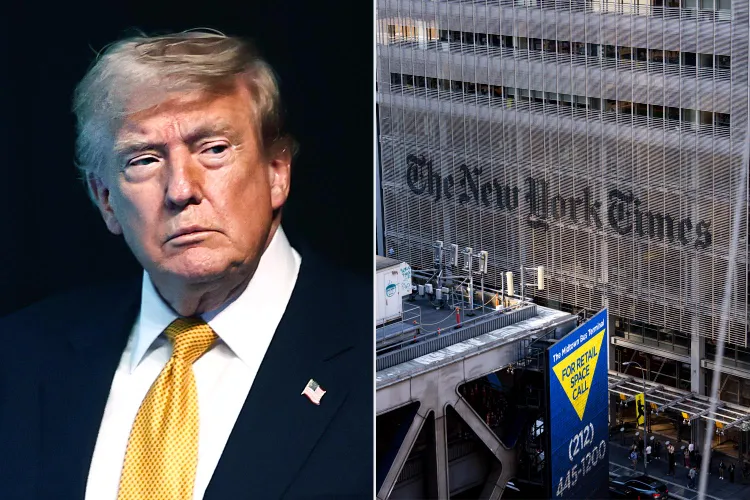
The Trump administration has subpoenaed several New York Times journalists. This came after the newspaper published reports on security concerns linked to President Donald Trump’s newly donated Air Force One.
According to People, The New York Times reported that the subpoenas targeted journalists Julian E. Barnes, Eric Lipton, Tyler Pager and Eric Schmitt. The subpoenas ordered them to testify before a federal grand jury in Manhattan on Wednesday, July 15.
Federal agents reportedly delivered some of the subpoenas directly to the journalists’ homes.
The Times said U.S. attorney Jay Clayton issued the subpoenas on Friday, July 10. The documents reportedly asked the journalists to testify “in regard to an alleged violation of federal criminal law.” However, they did not provide further details.
Trump, 80, nominated Clayton last month to serve as Director of National Intelligence.
New York Times criticises move
The New York Times condemned the subpoenas. Additionally, it described them as a major escalation in Trump’s pressure on independent media organisations.
The newspaper said the move followed its reporting on the president’s new Air Force One, a Boeing 747-8 donated by Qatar.
David McCraw, a lawyer for the newspaper, said federal agents showing up at reporters’ homes should disturb anyone. He explained this should concern anyone who believes in press freedom.
“The appearance of federal law enforcement agents on the doorstep of news reporters should shock the conscience of any American who believes in the Constitution and the press freedom it protects,” McCraw said.
He said the journalists had only reported facts in the public interest.
“Our journalists report the facts and advance the American public’s right to know how their government is operating and their taxpayer dollars are being used,” he added.
McCraw also accused the administration of trying to intimidate reporters.
“This brazen act should be seen as nothing more than an attempt to prevent the public from knowing what is happening in their country by intimidating journalists from doing their jobs,” he said.
Air Force One reports trigger attention
The subpoenas came after Trump flew the new Air Force One to a NATO summit in Turkey. He then left the country in the older presidential aircraft on Wednesday, July 8.
The Times reported that the Secret Service encouraged the aircraft swap as a security precaution.
Trump, however, wrote on Truth Social that he travelled in the older aircraft “for old time’s sake.”
The newspaper also reported on Thursday, July 9, that the Qatari-gifted Air Force One lacked some advanced protective features found on the original jet. These features included antimissile capabilities.
Both Times reports relied on anonymous sources.
People reported that an FBI official had asked the newspaper to hold the July 8 story. The official described the matter as an issue of national security. However, the official reportedly declined to explain why.
DOJ denies targeting reporters
A spokesperson for the Department of Justice told People that the government was not targeting reporters. Instead, they were investigating leaks of classified information.
“Reporters are not the targets, those leaking classified information are,” the spokesperson said.
The DOJ spokesperson said every administration had investigated leaks involving national security information.
“To the extent that we have to investigate breaches of national security, that’s something that we will continue to do,” the spokesperson added.
The department said it values the role of the press but also has a duty to protect classified information.
“We value and appreciate the important role that the press plays in this country, but DOJ also plays an important role to make sure that the people entrusted with our nation’s secrets do what they’re supposed to do with that information, which means not sharing classified information,” the spokesperson said.
The NYT journalists subpoenas have now raised fresh concerns over press freedom. Additionally, they have raised questions about national security investigations and the limits of government efforts to identify leaks.