





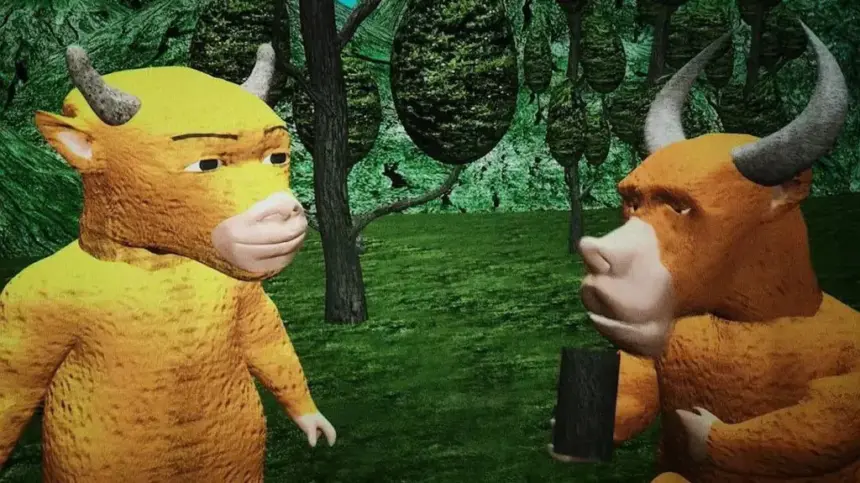
A low-budget Chinese animated film that was widely mocked online for its “disaster-level” visuals and confusing plot has become an unlikely box-office sensation, outperforming Hollywood heavyweights like Christopher Nolan’s The Odyssey and Spider-Man: Brand New Day in China .
Titled “Niu Lai” (The Cow Is Coming), the 86-minute animation follows a newborn calf and a skylark through an abstract dream sequence exploring themes of love, courage and sacrifice . When it debuted on August 5, the film seemed destined for obscurity — earning just 7,700 yuan (approximately $1,140) in its first 10 days with fewer than 300 viewers nationwide .
But on August 14, a social media post about its dismal earnings went viral, sparking a wave of curiosity . Chinese moviegoers flocked to cinemas to see for themselves just how bad the film really was .
“Out of curiosity and the joke, people just paid 30 yuan ($4.40) to check it out,” one social media user commented .
According to ticketing platform Maoyan, the film’s box office surged to 8.2 million yuan ($1.2 million) on Monday alone, with nearly 300,000 admissions . Total revenue has now reached 17.1 million yuan ($2.5 million) .
The film was reportedly made over five years by just two people — director Xin Yumeng and his mother, Sun Lifan — with a budget of around 1,680 yuan ($250) . They are credited as writers, directors, producers and voice actors .
Social media users have called it “unbelievably terrible and eye-opening,” a “symbol of the new internet troll culture,” and “worse than AI” . Some dubbed it the “worst movie of 2026” .
“You may regret for 80 minutes if you watch it, but if you don’t, you’ll regret it for life,” one popular post said .
Despite the criticism, the film’s crude, “hand-crafted” aesthetic has won it some defenders, particularly among viewers tired of AI-generated content . “That’s some serious craftsmanship,” one Weibo user wrote . Another called it the summer’s biggest “dark horse” .
Cinemas have added screenings to meet soaring demand, and with the film lacking a proper promotional poster, some staff have reportedly drawn their own by hand .
However, state-owned Beijing News has criticised the trend, warning that cinemas risk “losing the trust” of viewers if they “continue to lower their standard” with additional screenings of the film .