




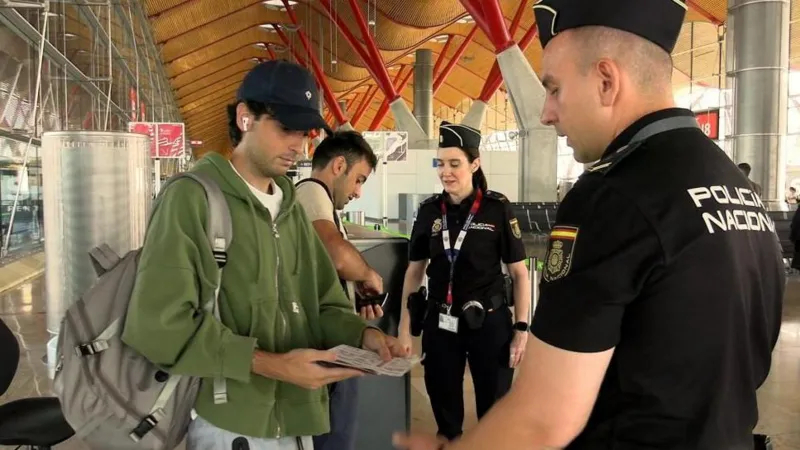
Spain has introduced border checks on travellers arriving from Italy. The Spain Italy border controls dispute deepens over the recent mass arrival of migrants in the Spanish enclave of Ceuta.
According to BBC, the measures took effect at midnight on Saturday. They are expected to remain in place for a month. Furthermore, they follow similar restrictions imposed by Italy after tens of thousands of migrants crossed from Morocco into Ceuta.
Spanish authorities are carrying out document checks on passengers arriving by air and sea from Italy. This marks a significant escalation in a dispute that has placed Prime Minister Pedro Sanchez and his Italian counterpart, Giorgia Meloni, on opposing sides.
Spain Italy border controls escalate Schengen dispute
The confrontation began after Italy temporarily reintroduced checks on people travelling from Spain. Italy argued the measure was necessary to prevent migrants who entered Ceuta irregularly from moving onwards to Italy.
Madrid strongly rejected that justification.
Spanish officials argued that the migrants in Ceuta did not have automatic access to the wider Schengen zone. Moreover, they accused Rome of using arguments that lacked a factual basis.
Spain initially demanded that Italy remove the restrictions. However, Rome refused and said its controls would remain until at least August 15.
Madrid then responded with restrictions of its own.
Spain says its checks will continue until September 7 unless circumstances change. Authorities have described the inspections as random. However, some travellers have reported that everyone aboard their flights was required to present identification.
The dispute has raised fresh questions about free movement within the Schengen area. The area normally allows travellers to cross participating European borders without routine passport checks.
Italy fears another migration surge
Rome has linked its decision partly to concerns about reports of another possible attempt by migrants to enter Ceuta in mid-August.
Spain has not officially announced that it expects another mass crossing.
However, social media posts encouraging another attempt have circulated online, with some Facebook groups attracting large numbers of followers. Meta has said content violating its policies has been removed.
The Spanish government has said it is monitoring the situation. It does not currently expect scenes similar to those witnessed during the recent influx.
Most of those who entered Ceuta have since returned to Morocco, although hundreds of minors remain in the Spanish territory.
The scale of the crossing also resulted in deaths. Authorities reported dozens of fatalities as people attempted to reach Ceuta by sea.
Questions remain over what triggered Ceuta influx
There is still no single confirmed explanation for why such a large number of people attempted to enter Ceuta within a short period.
Spanish authorities and European officials have pointed towards misinformation and criminal networks as possible factors.
The surge came after a Spanish Supreme Court ruling concerning the immediate return of migrants intercepted while attempting to reach Ceuta or Melilla.
Moroccan officials have argued that interpretations of that ruling weakened the deterrent against attempted crossings.
Questions have also been raised about the response of Moroccan border authorities. This comes particularly given the unusually large number of people who managed to reach the Spanish territory.
Ceuta and Melilla have long been sensitive points in relations between Madrid and Rabat. Morocco does not recognise Spanish sovereignty over the two North African enclaves.
Political tensions spread beyond Spain and Italy
The crisis has also divided European governments over how Spain handled the influx.
Italy’s tougher position has received support from some European countries. Meanwhile, other voices have called for wider action within the Schengen system.
At the centre of the row are two leaders with contrasting approaches to migration. Meloni has consistently pushed for tougher controls at Europe’s external borders. At the same time, Sanchez’s government has accused Italy of overreacting to the situation in Ceuta.
What started as an emergency on Spain’s border with Morocco has therefore developed into a broader European political dispute.
With both Madrid and Rome now checking travellers arriving from each other’s territory, the migrant crisis in Ceuta is increasingly testing relations between two major EU members. Additionally, it is testing the bloc’s commitment to border-free movement.