




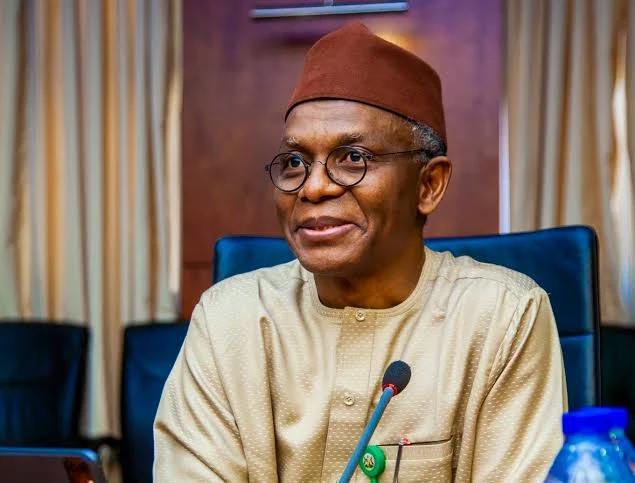
The Supreme Council for Shari’ah in Nigeria has appealed to the authorities handling the case of former Kaduna State Governor, Nasir El-Rufai, to ensure that his continued detention complies with the law and does not infringe on his fundamental rights.
The council maintained that El-Rufai, who is facing criminal prosecution, must be accorded due process and a fair hearing, noting that the allegations against him should not be used to erode the constitutional protections available to him.
In a statement signed by its Secretary General, Nafiu Baba Ahmad, the SCSN said it neither supported nor condoned criminal conduct but stressed that the pursuit of justice must equally be conducted within the boundaries of the law.
Recall that El-Rufai is currently facing a nine-count amended charge filed by the Independent Corrupt Practices and Other Related Offences Commission before the Federal High Court in Abuja.
The charges border on alleged abuse of office, fraud, irregular award and execution of public contracts, money laundering, conferring undue advantage and unlawful handling of public funds during his eight-year administration as Kaduna governor.
The former governor is also the subject of a separate five-count amended charge filed by the Department of State Services in connection with alleged unlawful recording of telephone conversations involving the National Security Adviser, Nuhu Ribadu.
El-Rufai has denied the allegations against him.
The Shari’ah Council argued that the former governor’s prosecution did not extinguish his constitutional rights, insisting that every accused person remained entitled to basic legal protections until proven guilty.
“As an organization committed to justice, fairness, and the rule of law, the Supreme Council for Shariah in Nigeria (SCSN) believes that Nigeria operates under a constitutional democracy where the rights and liberties of all citizens must be respected, irrespective of status, political affiliation, or personal disposition,” the council said.
It added, “The principles of due process, fair hearing, and lawful detention are not optional, but fundamental pillars of justice that must be upheld at all times.”
The organisation said it was especially troubled by the circumstances surrounding El-Rufai’s detention and called on the authorities to ensure that all actions taken in the case were firmly grounded in the Constitution and relevant laws.
It cautioned that disregarding due process could have implications beyond El-Rufai’s case, particularly if the proceedings were perceived as politically influenced, warning that such perceptions could weaken public confidence in government institutions.
“The Council therefore wishes to state unequivocally that it does not, under any circumstances, support or condone criminality in any form by anyone. However, the pursuit of justice must itself be just,” it said.
“Actions perceived as arbitrary, politically motivated, or inconsistent with the rule of law risk undermining public confidence in state institutions and eroding the very fabric of democratic governance.”
The council therefore urged the relevant authorities to refrain from actions that could give the impression that El-Rufai was being targeted or persecuted on account of his political activities.
“Accordingly, the Council calls on the relevant authorities to act strictly within the confines of the Constitution and all extant laws by ensuring that due process is followed at every stage,” the statement said.
It also called for fairness and transparency in the handling of the proceedings, arguing that the legitimacy of Nigeria’s institutions depended significantly on citizens’ confidence that justice was being administered without bias.
“Nigeria’s unity and long-term stability are inextricably tied to the credibility of its institutions and the trust reposed in them by the citizenry. Justice must not only be done but must be manifestly seen to be done,” the council said.
The intervention followed earlier criticism from former Rivers State Governor and African Democratic Congress vice-presidential candidate, Rotimi Amaechi, over El-Rufai’s continued detention. Amaechi had argued that some of the bail conditions imposed on the former governor appeared difficult to meet.
Amaechi, a lawyer, questioned the requirement that El-Rufai should depend on individuals linked to the authorities prosecuting his case to secure his release.
“I’m a lawyer, and it is difficult to speak about judges. We were taught in law school that if you want a man to be granted bail, you should not impose impossible conditions,” Amaechi said.
He maintained that bail should not effectively amount to punishment for a defendant who had yet to be convicted.
“The essence of bail is to look at, ‘Let’s not put this man away.’ What the bail is doing is making him serve his term when he has not been found guilty,” he said.
Amaechi further argued that keeping El-Rufai in detention for an extended period could create the impression that the former governor had already been found guilty before the trial was concluded.
“So, it is as though the court is assuming that he is guilty of a crime, when, in fact, the court has not found him guilty. He has been there since February. That is so unfair,” he said.
Former Vice President Atiku Abubakar has also said efforts were underway to secure El-Rufai’s release.
Atiku, the 2027 presidential candidate of the ADC, disclosed that his team had remained in contact with the former Kaduna governor while also providing support to his family during the legal proceedings.
“We are doing everything we can to see that El-Rufai is released. We visit him, send messages to him, and he also sends messages to us. We are also supporting his family,” Atiku said.