




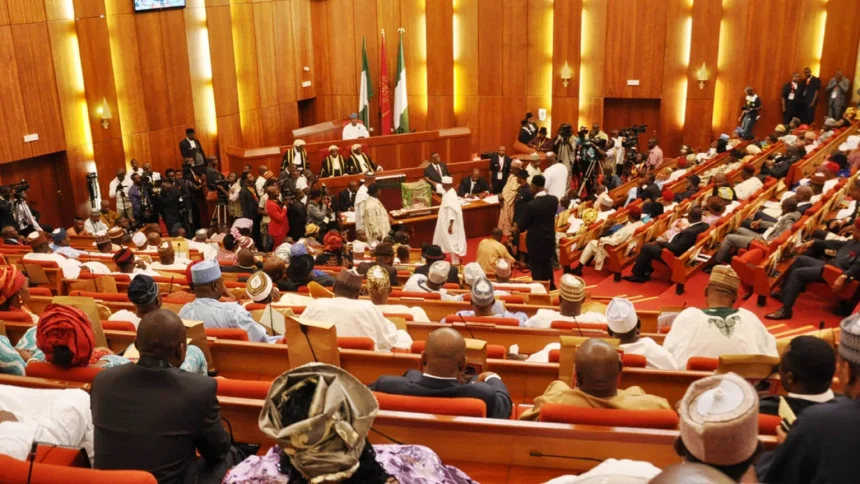
Senate Leader Opeyemi Bamidele has disclosed that the 11th Senate will consider a single term of six years for the President and state governors.
Speaking on the floor of the Senate, Bamidele said the proposed single term would allow leaders to focus on governance rather than spending time planning for re-election.
“I now see why one of the first sets of bills that I look forward to moving by God’s grace when we come back for the 11th Senate is for a bill that will only make it possible for anyone who wants to be President of this country or governor in any state of this country to spend only one tenure of six years,” he said.
“With this, you don’t even have to worry about wasting almost one and a half years of your first term thinking and struggling and looking forward to how you’ll be re-elected. If you know you are there for six years, only one tenure, you put in your best from day one. You know this is the only chance that you have.”
Bamidele also defended the 10th Senate against allegations that it functioned as a rubber-stamp legislature, insisting that the upper chamber deliberately adopted a strategy of constructive engagement with the executive rather than pursuing public confrontations.
Speaking during an interactive session ahead of the third anniversary of the 10th Senate in Abuja, Bamidele said many disagreements between the National Assembly and President Bola Tinubu’s administration were resolved behind closed doors in the national interest.
“We have worked collaboratively with the executive arm of government over the past three years. Some of our colleagues were labelled rubber stamps for doing so. But let me be clear: we knew we were not a rubber-stamp Senate,” he said.
The Senate Leader also defended the National Assembly’s decision to reject a proposal seeking a fresh probe of military spending in the fight against terrorism, arguing that subjecting the military to a public probe during an ongoing war would undermine national security efforts.
“Our military men are giving their best under extraordinarily difficult circumstances,” he said, stressing that existing legislative oversight mechanisms already provide accountability for military expenditures without jeopardising sensitive security operations.
Meanwhile, the Aare Ona Kakanfo of Yorubaland, Iba Gani Adams, called on President Tinubu and the National Assembly to urgently legislate a framework for the establishment of state police as part of efforts to strengthen the nation’s security architecture.
Adams argued that the present centralised policing system is inadequate to address localised and mounting security threats. He expressed deep concern over the recent surge in violent crimes in the South-West region, particularly the mass kidnapping of 39 students and seven teachers from three schools in Oyo State on May 15, 2026.
In a related development, a coalition of civil society organisations under the umbrella of Open Alliance called for greater attention to accountability, transparency, human rights protections and citizen participation in ongoing conversations around the proposed devolution of policing in Nigeria.
Participants at a stakeholder dialogue stressed that the effectiveness of any policing system depends not only on its structure but also on strong oversight institutions and safeguards for citizens’ rights. They emphasised that state police should not be seen as a standalone solution but as part of broader reforms aimed at improving trust, service delivery, and legitimacy in policing.