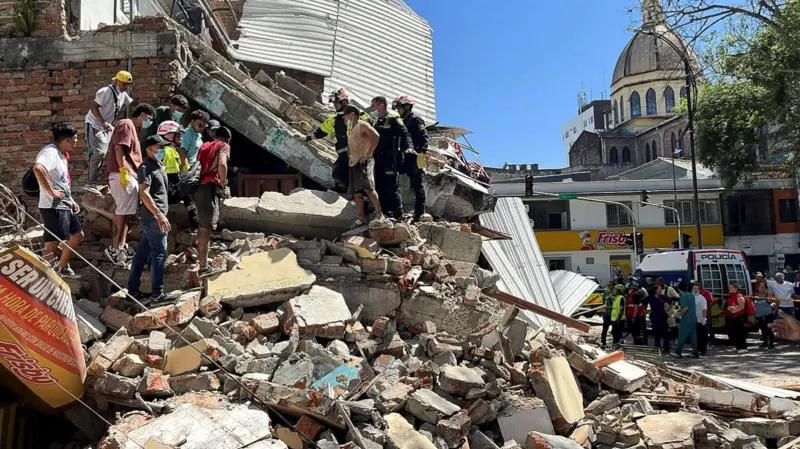
Search and rescue operations intensified early Tuesday across dozens of cities and towns in western Colombia after a powerful earthquake struck the region, killing at least 111 people and leaving others feared trapped beneath the rubble of collapsed and severely damaged buildings.
The 7.4-magnitude earthquake struck on Monday, shaking Cali, Quibdo, Pereira and several other communities.
Authorities reported that around 1,600 buildings had either been damaged or destroyed. Soldiers, emergency responders and residents joined forces at the disaster sites, manually clearing heavy slabs of concrete and passing debris through human chains of volunteers.
President Abelardo de la Espriella said Monday afternoon that the confirmed death toll had reached at least 111.
As relatives searched for missing family members, information about those unaccounted for was shared on citizen-operated websites. By Monday evening, more than 2,700 people had been listed as missing.
Dana Carolina Zamora shared a photograph of her 60-year-old uncle, Miguel Angel Zamora, holding his dog. The farmer was believed to have been living in a rural part of El Cairo, located close to the earthquake’s epicentre in San Jose Del Palmar.
Authorities reported that about 80% of El Cairo, which has a population of roughly 7,000, sustained damage.
Ms Zamora said she feared for her uncle because he lived in a traditional house constructed from sticks and mud, which she described as vulnerable to damage.
“We are afraid. We hope that is not the case, that he is all right and that it is only a communication failure. But we haven’t heard anything from him,” she said.
Choco, the region around the earthquake’s epicentre, is among Colombia’s poorest and most neglected areas and has long faced violence involving rival armed groups. Large parts of Choco can only be reached by boat, through dense jungle routes or by air, making it difficult for emergency teams to determine the full scale of the destruction.
Mr De la Espriella travelled to Quibdo, the capital of Choco, late Monday to inspect the devastation. He said he had activated “the entire military and police apparatus” in response to the disaster, with engineers, rescue personnel and search dogs deployed to affected areas.
The president also announced rental assistance for people whose homes were damaged, allowing them to secure temporary accommodation while repair work is carried out.
“Choco will never again be the ‘land of the forgotten’,” he said.
The disaster marks the first major challenge for Mr De la Espriella, who took office as Colombia’s president on Friday. He has become a polarising political figure following his pledge to launch an aggressive campaign against criminal organisations operating across the country.
The US State Department said it would provide 15.5 million dollars (£11.47 million) in emergency assistance, including shelter, food and other essential support. Other governments throughout Latin America also offered assistance as Colombia began responding to the disaster.
The earthquake has heightened anxiety in the Andean country, coming shortly after two consecutive earthquakes struck neighbouring Venezuela in late June. Those quakes destroyed hundreds of buildings and claimed more than 6,300 lives.
For many Colombians, attention was already shifting towards the broader and longer-term impact of the disaster.
Monica Sanchez, who runs a small business producing work uniforms, said her home city of Pereira was among the areas hardest hit. A wall inside her factory collapsed during the earthquake, but Ms Sanchez and her 12 employees managed to escape the building moments before it became more dangerous.
“It was shocking — the city fell down around us,” she said.