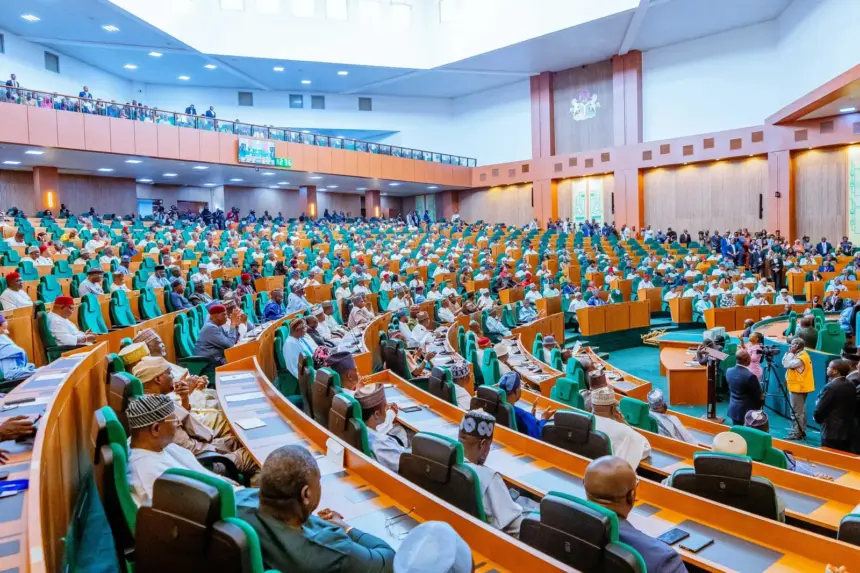
The House of Representatives has begun a clause-by-clause review of President Bola Tinubu’s executive bill. This bill seeks to establish state police in Nigeria.
According to Vanguard, the House Committee on Constitution Review started the detailed consideration of the proposed legislation. Lawmakers moved to accelerate its passage.
Deputy Speaker Benjamin Kalu, who chairs the committee, said members would use the version already passed by the Senate as their primary working document.
He indicated that the House might adopt most of the Senate’s amendments. This is because the executive bill closely resembles the state police proposal previously considered by the lower chamber.
House revisits earlier decision
Kalu recalled that the House passed its own Constitution Alteration Bill on state police on June 11. This happened before lawmakers proceeded on recess.
However, the chamber reversed that decision on July 14. This was after President Tinubu transmitted an executive bill on the same subject to the National Assembly.
“You may recall that on June 11, before the recess, the House considered and passed the Police Constitution Alteration Bill.
“However, following the introduction of an executive bill by the President, that decision was reversed by the House on July 14 to enable consideration of the executive bill coming from the Commander-in-Chief of the Armed Forces,” Kalu said.
He argued that the President, as Commander-in-Chief, was well positioned to propose broad security reforms. These reforms are designed to address Nigeria’s changing security challenges.
The executive bill has already passed its first and second readings in the House.
Kalu also said the extensive consultations conducted during the National Assembly Open Week satisfied the public hearing requirement for the proposed amendment.
“The bill has been referred to this committee, and the committee is not just the Deputy Speaker and the Deputy Chairman. The committee is you and I.
“Our responsibility is to carefully scrutinise this legislation and ensure that it reflects the aspirations and expectations of the Nigerian people,” he said.
Senate version becomes working draft
Kalu said the committee would examine every provision in the executive bill. They will then make recommendations before returning it to the House.
“The purpose of today’s meeting is to consider the executive bill clause by clause and make appropriate recommendations to the House.
“We must note that the Senate has already considered and adopted the bill with certain amendments, and copies of that version have been circulated to members. This document will serve as our working draft throughout this exercise,” he said.
According to him, the Senate introduced about eight minor amendments. These would not significantly alter the substance of the executive proposal.
The changes include the introduction of Section 318 on interpretation. There are also transitional and saving provisions intended to guide the implementation of the proposed state police framework.
The Senate also included other consequential amendments designed to support the operation of a multi-level policing system.
“On the clause-by-clause consideration, the executive bill is substantially similar to what we have previously worked on, with only minor adjustments.
“Therefore, we do not anticipate any major departure from the work already undertaken,” Kalu said.
He added that the committee would examine the Senate’s amendments and adopt them where appropriate. This is to reduce delays in the constitutional amendment process.
Tinubu’s security reform agenda
Kalu described the establishment of state police as one of Tinubu’s major constitutional reform initiatives.
He said the President had supported decentralised policing since his time as governor of Lagos State.
“I must emphasise that the state police bill remains one of the signature constitutional reform initiatives of President Bola Ahmed Tinubu.
“As governor of Lagos State, he was among the earliest advocates of multi-layered policing as a strategic solution to Nigeria’s security challenges.
“Today, as President, he is championing the same cause, demonstrating consistency between his convictions and his actions,” Kalu said.
The Deputy Speaker maintained that the executive and legislative arms remained separate. However, they could work together on issues affecting national security.
He said the urgency attached to the bill prompted lawmakers to meet on Monday. This was outside the House’s usual Tuesday sitting schedule.
“We are here today not because it is convenient for us. Our parliamentary week ordinarily begins on Tuesday, but duty calls, and time is of the essence.
“We are joining hands with the executive to ensure that this collaborative effort results in the successful passage of this priority constitutional amendment,” he said.
Lawmakers seek speedy passage
Kalu disclosed that the House and Senate were working together to harmonise their positions. This would help accelerate the passage of the bill.
He expressed confidence that Tinubu would assent to the legislation after lawmakers complete the required constitutional process.
The proposal seeks to create a constitutionally recognised multi-tier policing system. This system would allow states to establish police services while retaining the federal police structure.
Supporters argue that state police would improve response times. Furthermore, it would enable security officers familiar with local languages, geography and communities to address crimes more effectively.
However, critics have raised concerns about funding, political interference and the possibility of governors misusing state-controlled police formations against opponents.
The committee is expected to consider the safeguards contained in the bill before submitting its recommendations to the House for further legislative action.
As a constitutional amendment, the proposal must receive the required support in both chambers of the National Assembly. It must also have approval from at least two-thirds of the state Houses of Assembly before it can be presented to the President for assent.