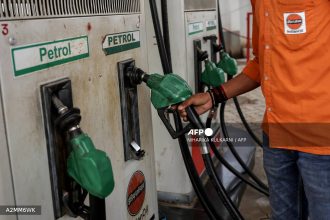




Oil prices surged higher and showed no signs of halting their rapid climb a week after the United States and Israel launched major attacks on Iran that escalated into a full-scale war in the Middle East, with the fallout ratcheting up what consumers and businesses will pay at the pump worldwide.
The conflict, in which nearly every country in the Middle East has sustained damage from missiles or drone strikes, has left ships that carry roughly 20 million barrels of oil a day stranded in the Persian Gulf, unable to safely pass through the Strait of Hormuz, the narrow mouth of the Gulf bordered on its north side by Iran .
Oil prices surpassed $90 a barrel Friday, with American crude settling at $90.90, up 36% from a week ago, and Brent, the international standard, climbing 27% over the course of the week to land at $92.69 .
The shipping disruption and damage to key Middle East oil and gas facilities has interrupted supplies from some of the world’s largest oil producers. Kuwait said on Saturday that it would reduce its oil production as a “precautionary” measure due to the war, which could jolt global energy markets even further .
“The more news we get, the more it seems like this is going to last a really long time,” said Al Salazar, head of macro oil and gas research at Enverus .
President Donald Trump said Monday that the U.S. expected its military operations against Iran to last four to five weeks but has “the capability to go far longer.” On Friday, Trump appeared to rule out talks with Iran absent its “unconditional surrender” .
In the United States, a gallon of regular gasoline rose to $3.41 on Saturday, up about 43 cents from a week ago, according to AAA motor club. Diesel was selling for $4.51 a gallon Saturday, up about 75 cents from last week .
The price shocks were felt even more heavily in Europe and Asia, markets that rely more heavily on energy supplies from the Middle East. Diesel prices doubled in Europe, and jet fuel prices rose by close to 200% in Asia, according to Claudio Galimberti, chief economist at Rystad Energy .
Energy prices climbed throughout the week as Iran launched a series of retaliatory attacks, including a drone strike on the U.S. Embassy in Saudi Arabia. Iran also hit a major refinery in Saudi Arabia and a liquefied natural gas facility in Qatar, halting flows of refined products and taking about 20% of the world’s LNG supply offline .
“We keep seeing news of vessels being hit or refineries or pipelines, so the list is very long,” Galimberti said. As a result, roughly 9 million barrels of oil per day are off the market because of facilities being hit or producers taking precautionary measures, he said. “Right now, with all of this shut in, we are in a situation of extreme deficit” .
In Nigeria, the global oil crisis has translated into sharp increases at the pump, with petrol prices climbing above N1,000 per litre in several states after the Dangote Petroleum Refinery increased its gantry price of Premium Motor Spirit to N995 per litre, triggering retail price adjustments nationwide .
According to reports petrol now sells between N1,000 and N1,190 per litre depending on location and retail outlet .
In Lagos, the country’s commercial hub, petrol prices climbed as high as N1,190 per litre in some outlets early on Saturday.
In the Federal Capital Territory, most filling stations now sell petrol between N1,052 and N1,105 per litre.
In Gombe, petrol sells for between N1,080 and N1,250 per litre, with Bovas Petroleum offering the lowest price at N1,080 per litre while other stations sell between N1,150 and N1,250 per litre.
The price hike has already begun to impact transport fares and the broader cost of living across Nigeria.
The PUNCH reported that commercial drivers operating along the Federal Secretariat-Asokoro route in Abuja had increased fares from N400 to N700 to cope with rising fuel costs. “Fuel is now more than N1,000 per litre. I bought petrol at N1,060 today. If I don’t increase the fare, I will run at a loss,” a commercial Daniel Ishyaku said.
A dispatch rider in Lagos, Augustine Akor, said the increase had forced him to raise delivery charges. “I bought fuel at N1,018 in Iju-Ishaga this morning. I delivered a package to Ogba and had to charge N4,800 instead of N4,000 because of the fuel increase,” he said .
A boutique owner, Chukwudi Anioke, said the rising cost of fuel could force him to increase prices of goods in his shop. “I pay for Band A electricity but power supply is not stable, so I rely heavily on my generator. Now that petrol has increased again, we will have no option but to increase prices,” he said .
In Gombe, a commercial motorcyclist, Ibrahim Musa, said the high cost of petrol has significantly affected his daily income. “We are really suffering. Before now, I could buy fuel with less money and still make a profit at the end of the day. Now, most of what we make goes back into buying petrol,” he said .
Residents across the country expressed frustration over the development. A resident of Sokoto, Abdulazeez Bello said “The price of fuel is now on the other side. How does the government expect us to survive?” .
A Bauchi resident, Umar Musa, said the increase had already affected his livelihood. “With this kind of increase, commodity prices will also rise in the market,” he said .
Despite the price increase, fuel was readily available at stations visited across most states, and there were no long queues, though some parts of Jigawa State witnessed panic buying amid fears of further hikes .
Analysts caution that rising petrol prices often trigger a chain reaction across the economy, as higher transportation and energy costs typically translate into increased food prices, rising production costs, and higher market prices for essential goods .
With petrol now selling above N1,000 per litre in several states, many Nigerians fear the economic ripple effects may only just be beginning .