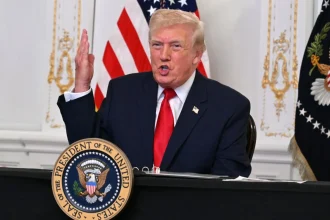
The announcement of a two-week ceasefire by Donald Trump, delivered just 90 minutes before his deadline for Tehran to reopen the Strait of Hormuz or face severe military action, marked a significant moment for Pakistan.
The development comes as the country continues to grapple with the economic strain caused by the global energy crisis triggered by the conflict with Iran.
The situation may unsettle some observers in India, particularly within foreign policy circles where dismissive remarks about Islamabad’s role had previously surfaced.
However, the unfolding events underscored Pakistan’s growing importance in the diplomatic landscape surrounding the crisis.
Trump’s statement explicitly acknowledged Pakistan’s involvement.
“Based on conversations with Prime Minister Shehbaz Sharif and Field Marshal Asim Munir, of Pakistan, and wherein they requested that I hold off the destructive force being sent tonight to Iran, and subject to the Islamic Republic of Iran agreeing to the complete, immediate, and safe opening of the Strait of Hormuz, I agree to suspend the bombing and attack of Iran for a period of two weeks,” the US President wrote on Truth Social at 4.02am Wednesday, India time.
A statement from Iranian Foreign Minister Seyed Abbas Araghchi also began by recognising Islamabad’s role.
“On behalf of the Islamic Republic of Iran, I express gratitude and appreciation for my dear brothers HE Prime Minister of Pakistan Sharif and HE Field Marshal Munir for their tireless efforts to end the war in the region,” Araghchi wrote.
“In response to the brotherly request of PM Sharif in his tweet, and considering the request by the U.S. for negotiations based on its 15-point proposal as well as announcement by POTUS about acceptance of the general framework of Iran’s 10-point proposal as a basis for negotiations, I hereby declare on behalf of Iran’s Supreme National Security Council:
If attacks against Iran are halted, our Powerful Armed Forces will cease their defensive operations.
“For a period of two weeks, safe passage through the Strait of Hormuz will be possible via coordination with Iran’s Armed Forces and with due consideration of technical limitations.
Minister of Foreign Affairs Islamic Republic of Iran,” Araghch added.
Shortly afterward, Pakistan’s Prime Minister Shehbaz Sharif shared a message on X acknowledging the breakthrough while maintaining a measured tone regarding Islamabad’s role.
“With the greatest humility, I am pleased to announce that the Islamic Republic of Iran and the United States of America, along with their allies, have agreed to an immediate ceasefire everywhere including Lebanon and elsewhere, EFFECTIVE IMMEDIATELY.
I warmly welcome the sagacious gesture and extend deepest gratitude to the leadership of both the countries and invite their delegations to Islamabad on Friday, 10th April 2026, to further negotiate for a conclusive agreement to settle all disputes,” Sharif wrote.
“Both parties have displayed remarkable wisdom and understanding and have remained constructively engaged in furthering the cause of peace and stability. We earnestly hope, that the ‘Islamabad Talks’ succeed in achieving sustainable peace and wish to share more good news in coming days!” he added.
Analysts and commentators were quick to highlight Pakistan’s diplomatic gains. Michael Kugelman, a senior fellow for South Asia at the Atlantic Council, described the development as a major success.
“Tonight, Pakistan achieved one of its biggest diplomatic wins in years. It also defied many skeptics and naysayers that didn’t think it had the capacity to pull off such a complex, high stakes feat. But what matters the most is it helped avert a potential catastrophe in Iran,” Kugelman wrote on X.
Sadanand Dhume offered a similar assessment, noting: “Whichever way you slice it, this is a huge diplomatic win for Pakistan. Islamabad comes across as a responsible actor with enough trust in key world capitals to help avert a potential global catastrophe.”