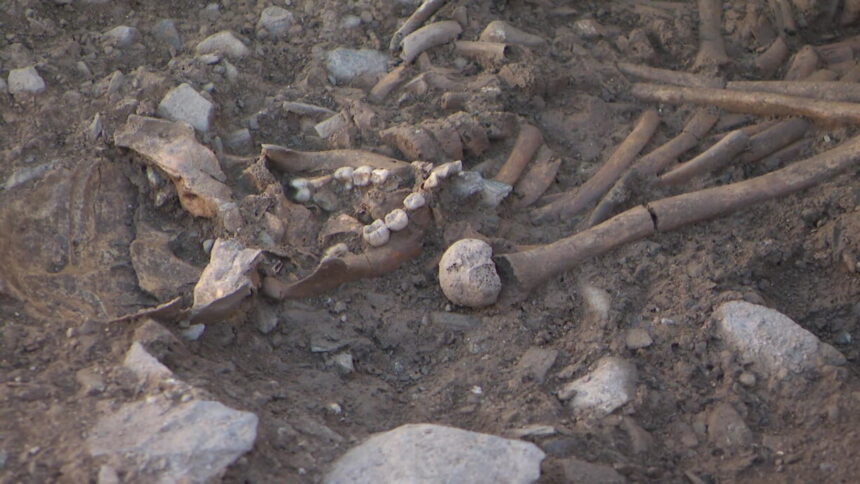
Archaeologists working at a construction site in Vianden, Luxembourg, have uncovered more than 150 human skeletons, revealing the extent to which medieval remains survived beneath a car park where a new youth hostel is being built.
The remains were discovered during archaeological work associated with the construction project.
Researchers believe the burial ground was linked to the Trinitarian Church, a religious building dating to the 13th century. Luxembourg’s Culture Minister Eric Thill visited the site on Wednesday to examine the discoveries.
Interest in the location began in 2021, when workers carrying out electrical installation work uncovered a Gothic window. The finding prompted archaeologists to conduct more focused investigations, eventually directing their attention to a cemetery believed to lie beneath the Place de la Résistance car park.
Archaeologists had previously believed that much of the medieval archaeological record in the area had been destroyed during the Second World War. As construction advanced, however, precautionary measures were introduced to protect any material that might remain underground. Subsequent investigations showed that substantial archaeological evidence had survived.
The National Institute for Archaeological Research (INRA) was then brought in and ordered preventive excavations. Those investigations have since produced more than 150 skeletons, turning the site into a significant archaeological discovery.
Andrea Bischof of the INRA said the number of remains recovered had exceeded expectations. “Contrary to what had long been believed, the war did not destroy everything on site”, she continued.
Construction of the youth hostel has consequently been paused to give archaeologists time to document and recover the remains systematically. Excavations have been continuing since January, with researchers hoping to finish the work before the end of the year.
The absence of clothing and other associated material has made it difficult to establish precisely when the people were buried. Nevertheless, the remains are already providing researchers with information about the health of the population that once lived in the area.
Examination of the bones has revealed evidence of injuries and infections. Among the discoveries was the skeleton of a young child who had suffered a serious sinus infection that had progressed into the bone. Bischof described the case as particularly moving, while cautioning that researchers cannot yet establish whether the infection caused the child’s death.
The recovered remains are currently undergoing cleaning and detailed examination by an external specialist. According to Bischof, samples are routinely preserved so they can be used for further scientific research.
The treatment of the human remains is also covered by a new agreement between the INRA and the Catholic Church. Under the arrangement, the remains will eventually be reburied in a dedicated grave within a cemetery, following established ethical standards.
The excavation is taking place under Luxembourg’s 2022 Heritage Law, which strengthened the framework and resources available for archaeological investigations. Thill said preventive archaeology involves investigating sites before construction takes place so that archaeological evidence can be identified and protected in advance.
The minister said the recently introduced approach “now sees the state fully covering the costs of such preventive operations”.
The scale of the excavation has also brought significant costs. The INRA estimates that the archaeological work at the Vianden site will run into the “several hundreds of thousands of euros”.
Researchers are continuing to document the cemetery and study the recovered remains as construction work remains suspended. The excavation is expected to continue through the year as archaeologists seek to establish more about the people buried at the site and the history of the former cemetery.