Crude oil prices recorded a modest decline ahead of the opening of European markets, as investors assessed remarks by United States President, Donald Trump, indicating that Washington would assist vessels in exiting the Strait of Hormuz starting today.
The proposal, however, has been rejected by Iran.
As of the latest data, U.S. benchmark crude (WTI) dipped by 0.28% to $101.65 per barrel, while Brent crude, the global benchmark, slipped marginally by 0.06% to $108.10 per barrel. Market direction remains closely tied to developments surrounding the conflict with Iran and efforts to ease congestion in the strategically vital Strait of Hormuz.
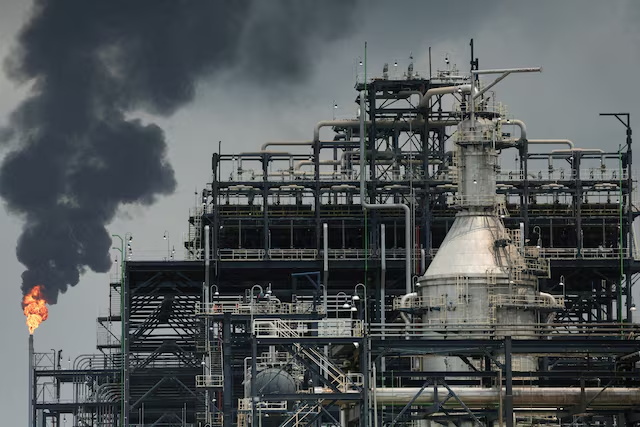
According to Stephen Innes of SPI Asset Management, the oil market continues to face significant strain, with numerous tankers and cargo vessels stranded across the Gulf due to storage limitations. He noted that production shutdowns are occurring as available storage capacity is exhausted.
Trump announced that a plan dubbed “Project Freedom” would commence Monday morning in the Middle East. The U.S. Central Command disclosed that the operation would involve guided-missile destroyers, over 100 aircraft, and approximately 15,000 personnel, though the Pentagon has yet to clarify deployment specifics.
In Asian markets, trading activity showed mixed results. Hong Kong’s Hang Seng Index rose 1.4% to close at 26,135.47. Markets in mainland China and Japan remained shut due to Golden Week holidays. Australia’s S&P/ASX 200 edged down 0.3% to 8,704.70.
Technology stocks drove strong gains in South Korea, with the Kospi climbing 3.8%, while Taiwan’s Taiex surged by 4.2%.
On Wall Street, the S&P 500 advanced 0.3% to reach a new record high of 7,230.12, marking its fifth consecutive week of gains. Meanwhile, the Dow Jones Industrial Average declined by 0.3% to 49,499.27, while the Nasdaq Composite rose 0.9% to close at an all-time high of 25,114.44.
Shares of Apple Inc. led the rally after reporting stronger-than-expected earnings, with its stock rising 3.3%, significantly boosting the S&P 500.
Over the long term, stock market performance tends to align with corporate earnings, and U.S. companies have continued to outperform expectations in the first quarter of 2026 despite concerns linked to the Iran conflict and elevated oil prices.
Data from FactSet shows that just over a quarter of S&P 500 companies have reported earnings so far, with 84% exceeding analysts’ forecasts. The index is projected to achieve approximately 15% year-on-year profit growth.
Uncertainty surrounding oil price movements remains a key concern for the global economy, particularly due to the ongoing conflict involving Iran. Prices had surged last week amid fears that prolonged disruption in the Strait of Hormuz could delay global oil shipments.
Before the conflict, Brent crude traded slightly above $70 per barrel. The price spike contributed to stronger-than-expected quarterly earnings for major U.S. oil firms, although their share prices declined. Exxon Mobil fell by 1%, while Chevron Corporation dropped 1.4%, as both companies reported year-on-year declines in net income.
In early Monday currency trading, the U.S. dollar strengthened to 157.18 Japanese yen from 156.80 yen, while the euro weakened to $1.1724 from $1.1746.