




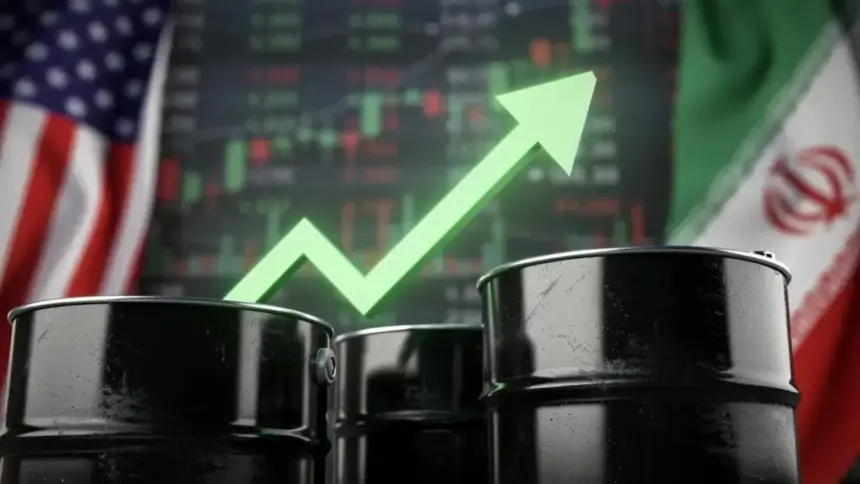
Oil prices reduced their gains on Monday after Iran said diplomatic exchanges with the United States were continuing through mediators despite renewed fighting in the Middle East.
According to Vanguard, Brent crude and US benchmark West Texas Intermediate initially extended last week’s rally as investors feared that the conflict could cause a prolonged disruption to shipments through the Strait of Hormuz.
Crude prices have risen sharply over the past week as Washington and Tehran exchanged attacks, raising concerns about supplies passing through the strategic waterway, which normally carries about a fifth of the world’s seaborne oil.
Brent rose above $91 per barrel during Monday’s trading, reaching its highest level since June 11, before retreating to around $89.
At about 8:10 GMT, Brent North Sea crude was up 0.87 per cent at $88.87 per barrel, while WTI gained 0.46 per cent to trade at $82.87.
Diplomatic signals cool oil rally
The market eased from its earlier peak after Iran confirmed that intermediaries had continued to transmit messages between Tehran and Washington.
“We have received messages — without going into details — but the main point is that the diplomatic apparatus has been active in recent days and ideas have been conveyed to us by certain mediators,” Iranian Foreign Ministry spokesman Esmaeil Baghaei said during a news conference in Tehran.
The disclosure gave traders some hope that both sides could still pursue negotiations despite the continued military exchanges.
However, concerns about the Strait of Hormuz continued to support oil prices. Any long-term interruption to the route could reduce global energy supplies and increase transport and insurance costs.
The renewed conflict had already pushed both crude benchmarks more than four per cent higher at the end of the previous week.
Markets weigh inflation and growth risks
The rise in oil prices has renewed concerns about inflation because higher energy costs can increase transport, production and household expenses.
Persistently high inflation could also make it more difficult for central banks to reduce interest rates.
However, Stephen Innes of SPI Asset Management said investors were considering two different economic developments at the same time.
“Markets are once again being forced to trade two seemingly contradictory stories on the same screen,” Innes said.
While the conflict had introduced a fresh geopolitical risk premium into oil markets, he said cooling underlying inflation and a weaker labour market in the United States suggested that the energy shock might not lead to another broad increase in prices.
Instead, he warned that the greater threat could emerge if expensive oil continued for long enough to reduce household spending and weaken economic growth.
Asian and European markets mixed
Stock markets recorded mixed performances as investors monitored the conflict and expectations of further economic support from China.
Hong Kong’s Hang Seng Index gained 2.36 per cent to close at 25,143.05, while the Shanghai Composite rose 0.85 per cent to 3,796.28.
Investors extended a recent rally in Chinese markets following expectations that Beijing could introduce additional measures to support the economy after the release of economic data last week.
Manila and Jakarta also recorded gains.
However, Seoul fell 4.46 per cent, while markets in Taipei, Sydney, Mumbai, Bangkok, Singapore and Kuala Lumpur also declined.
In Europe, London’s FTSE 100 fell 0.42 per cent, while Paris and Frankfurt recorded modest gains.
The mixed performance followed losses on Wall Street on Friday as investors reduced their exposure to technology companies and monitored developments in the Gulf.
Technology shares also faced pressure after Chinese startup Moonshot AI released its Kimi K3 model, which some experts said could compete with advanced products developed by American artificial intelligence companies.
Meanwhile, gold fell 0.25 per cent despite the geopolitical uncertainty, while silver advanced by slightly more than one per cent.
Investors are expected to continue monitoring military developments in the Gulf and any progress made through intermediaries between Iran and the United States.
A diplomatic breakthrough could reduce the risk premium added to oil prices, while further attacks around the Strait of Hormuz could send crude prices higher again.