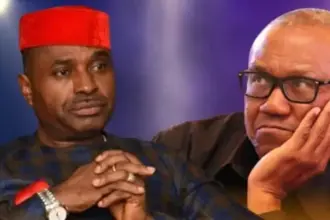
Former Executive Secretary of the National Health Insurance Scheme, Usman Yusuf, has downplayed the likelihood that a political alliance between Peter Obi and Rabiu Kwankwaso could significantly challenge President Bola Tinubu’s re-election prospects in 2027, insisting the arrangement lacks sufficient electoral strength to dislodge the ruling All Progressives Congress.
Yusuf made the remarks during an analysis of emerging political realignments on Daily Politics, a programme on Trust TV, where he assessed opposition strategies ahead of the next general elections. He acknowledged that while Kwankwaso’s influence might offer Obi some level of traction in northern Nigeria, such a partnership would still fall short of delivering a nationwide breakthrough.
He argued that political sentiment in the North remains largely unfavourable to Obi, citing lingering perceptions about his past political conduct among some voters in the region.
“Kwankwaso is the vehicle to sell Peter Obi to the North, but we have the record of what Peter Obi did to Northerners,” Yusuf said.
The former NHIS boss further dismissed growing speculation around a possible Obi-Kwankwaso coalition, describing it as politically overstated and unlikely to shift the current balance of power ahead of 2027.
“Peter Obi and Kwankwaso can pitch their tent anywhere, but they won’t make a dent,” he stated.
He also warned that Kwankwaso, the former presidential candidate of the New Nigeria Peoples Party (NNPP), could weaken his political base in northern Nigeria if he aligns too closely with Obi.
In a separate contribution, political analyst Professor Usman echoed similar sentiments, asserting that former Vice President Atiku Abubakar remains a more formidable figure in Nigeria’s opposition politics compared to both Obi and Kwankwaso.
“Atiku was stronger than Obi and Kwankwaso, that’s why they ran away,” he said.
Yusuf further revisited the 2023 presidential election, arguing that President Tinubu’s victory was largely secured through support from Northern Muslim voters rather than the South-West region alone.
“It wasn’t the Southwest that brought Tinubu to power, it was Northern Muslims, and they are now the ones he’s fighting,” he added.