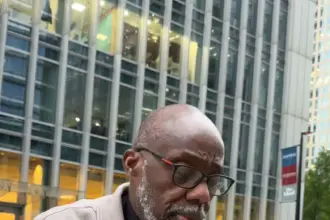
Political analyst Kabiru Ojo has stated that former President Goodluck Jonathan may struggle to gain the support of the northern political establishment ahead of the 2027 general elections.
He attributed this to regional political calculations, concerns over power rotation, and distrust among northern elites.
Ojo made the remarks during an exclusive interview with DAILY POST while weighing in on growing speculation surrounding Jonathan’s possible return to presidential politics.
The debate intensified after reports emerged that a faction of the Peoples Democratic Party (PDP) had adopted him as its preferred presidential candidate.
The Tanimu Turaki-led Interim National Working Committee of the PDP recently announced Jonathan as its sole presidential candidate for the 2027 elections following an internal screening process. Former Niger State governor, Mu’azu Babangida Aliyu, who is a member of the committee, said Jonathan received a waiver because of his status as a former president.
Jonathan’s camp, however, distanced itself from the development. His Special Adviser, Jude Imagwe, dismissed claims that the former president had accepted the nomination or obtained nomination forms.
“There is no suggested evidence that my boss has purchased or obtained any form,” Imagwe said.
“Some people said they granted him a waiver. I do not know anything about that. People are just trying to create ceremony around it.”
He further stressed that Jonathan had yet to make any official declaration regarding the race.
“I find it difficult to say right now that my boss is contesting. It should not be announced for him. It is his decision to take,” he said.
Commenting on the broader political conversation, Ojo noted that perceptions of Jonathan’s possible return differ across social classes in Northern Nigeria. According to him, ordinary citizens may remember Jonathan’s administration more favourably because of the economic situation at the time, while political elites are likely to resist his comeback.
“For the common man in the North who only thinks about survival, many will tell you they prefer Jonathan’s time over the present administration because there was no hunger then,” Ojo said.
“But the major challenge at that time was insecurity. Today, people are facing both hunger and insecurity. Can Jonathan handle and end the current full-blown insecurity if he returns?”
He argued that support for Jonathan would diminish if a northern candidate also enters the race.
“If there is a Northern candidate, the average Northerner will not support Jonathan coming back,” he said.
Ojo also claimed that northern political elites remain wary of Jonathan’s return because they may view it as an opportunity for political retaliation linked to the events of the 2015 election.
“The elites will not want Jonathan to come back because they will see it as a payback period. They believe he may remember how a coalition was formed against him and he was removed from office.”
The analyst further suggested that some northern stakeholders could still encourage Jonathan’s participation in the race for strategic reasons, particularly within the PDP.
“If Jonathan comes in on the PDP platform, it may complicate Tinubu’s path and prevent a one-party situation,” he said.
He added that the emergence of multiple strong contenders, including Peter Obi and Jonathan, could divide votes across regions and alter the political balance ahead of the election.
Addressing the issue of zoning and power rotation, Ojo maintained that the arrangement is political rather than constitutional.
“Rotation is not written in the constitution. It is an arrangement for unity,” he said.
“Since 1999, the South has produced presidents for about 18 years, while the North has had about 10 years.”
He identified Olusegun Obasanjo, Jonathan, and Bola Ahmed Tinubu as southern leaders, while Umaru Musa Yar’Adua and Muhammadu Buhari represented the North.
According to Ojo, the imbalance in years spent in power continues to shape debates around fairness and zoning ahead of the 2027 elections.
He concluded that despite the attention Jonathan’s name continues to attract nationwide, his chances within northern political circles remain slim.
“In reality, Jonathan is not a strong option for the Northern political bloc going into 2027,” he said.
In a separate interview, another Kano-based political analyst, Aminu Rabiu, said the administrations of Buhari and Tinubu have significantly changed public perception of Jonathan.
Rabiu argued that events after Jonathan left office have strengthened his image and led many Nigerians to reassess his presidency.
“Without fear of contradiction, I can say that former President Goodluck Jonathan’s post-presidency image has greatly improved,” he said.
According to Rabiu, Jonathan was once heavily criticised for his handling of corruption and insecurity, but changing national realities have altered those views.
“During and immediately after his presidency, Jonathan was perceived as corrupt and inept, especially in the context of corruption and insecurity,” Rabiu noted.
He said the inability of subsequent administrations to fully tackle insecurity and corruption has prompted many Nigerians, especially in the North, to reconsider Jonathan’s record in office.
Rabiu also described Jonathan as a committed democrat whose post-presidency activities have strengthened national unity and democratic engagement across Africa.
He noted that Jonathan’s involvement in election observation missions and peace mediation initiatives has enhanced his international reputation and contributed to his renewed public acceptance.
The analyst added that Jonathan could still emerge as a formidable candidate if backed by a strong political platform.
“If the contest could be Jonathan versus Tinubu, I believe the Northern electorate will go for the former,” he said.
Despite this, Rabiu maintained that Jonathan’s time in presidential politics may already be over, noting that he had effectively spent more than a full term in office.
“He, in fact, served for six years, first as Acting President from 2009 to 2010, and then as Executive President from 2010 to 2015,” he said.
Rabiu concluded that although Jonathan’s image has improved considerably, he does not believe the former president should return to contest for the presidency, while acknowledging that the courts and the law would ultimately determine his eligibility.
Meanwhile, a suit before the Federal High Court is seeking clarification on whether Jonathan is constitutionally eligible to contest the 2027 presidential election. The case argues that his succession to office in 2010 and subsequent victory in 2011 amount to two constitutional terms. Judgment in the matter has been scheduled for May 26.