







The National Orientation Agency has called on the National Assembly to criminalise the act of scooping fuel from fallen tankers.
The call was contained in a statement posted on the NOA’s official X account and attributed to the Director General, Mallam Lanre Issa-Onilu.
The appeal follows growing concerns over repeated fuel tanker accidents, including a recent incident at Apapa.
Issa-Onilu condemned the practice in strong terms, describing it as dangerous, irresponsible, and wholly unacceptable in a modern society. He emphasised that the risks go beyond those directly involved, endangering motorists, nearby communities, emergency responders, and national infrastructure.
“This is not poverty. Poverty does not take away the sense in people’s heads, nor does it eliminate judgement or the instinct for self-preservation. What we are witnessing is a conscious, reckless, and criminal disregard for human life and public safety,” he said.
The Director General noted that the NOA has long carried out nationwide sensitisation campaigns to educate citizens on the dangers of fuel scooping, yet some people persist in the act despite repeated warnings.
Issa-Onilu urged the National Assembly to pass legislation that explicitly criminalises fuel scooping and imposes clear, deterrent penalties on offenders. He stressed that public enlightenment must now be backed by strong enforcement to stop the deadly behaviour.
Fuel tanker accidents triggered by scooping remain a major threat to public safety and national infrastructure, with Nigeria recording multiple tragedies and mass casualties over the years.
In one of the deadliest recent cases, a petrol tanker overturned near Suleja in Niger State in January 2025, and more than 100 people who gathered to scoop spilled fuel died when the tanker exploded, with dozens others injured.
Reports from the Federal Road Safety Corps Benue Sector Command indicate that at least 411 Nigerians died while scooping fuel from crashed tankers in 2024 alone.
Criminalising the act is expected to curb preventable deaths, enhance safety for emergency responders, and foster a culture of responsibility and self-preservation.
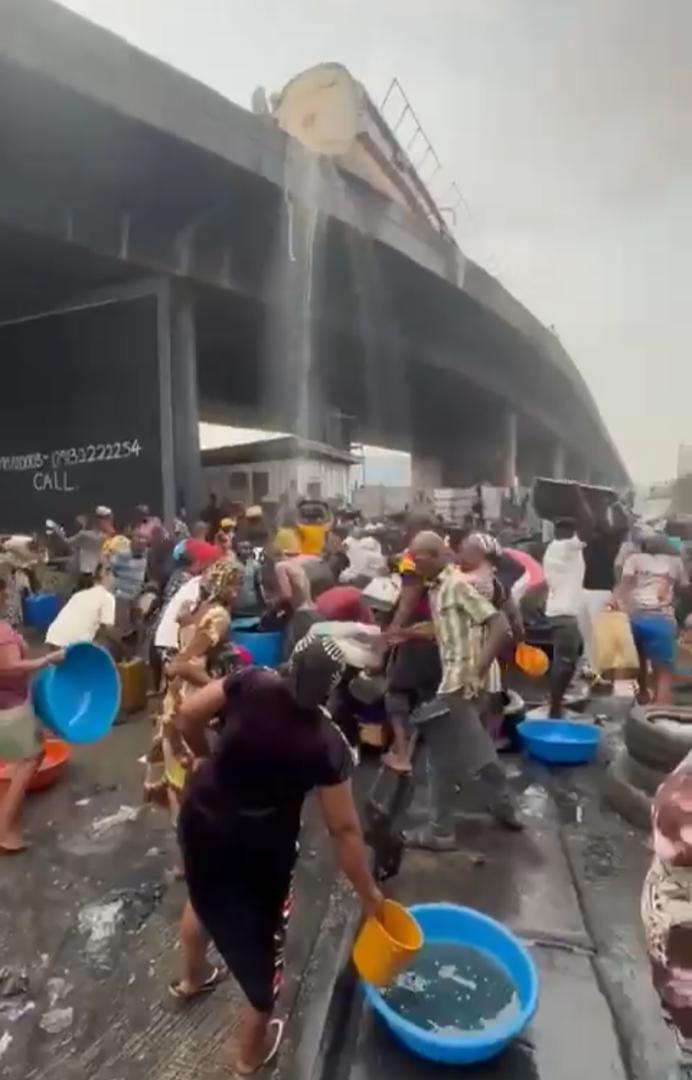
The NOA’s call was prompted by the latest incident in which a diesel-laden tanker overturned on the Tincan Liverpool Bridge in Apapa, Lagos State.
The spilled cargo attracted residents and passersby who rushed to collect the highly flammable fuel in jerrycans and other containers.
Emergency responders promptly intervened and contained the situation, averting a potential catastrophic explosion.


