Nigeria’s solid minerals exports rose to N354bn in 2025. This strengthened the Federal Government’s push to grow the mining sector and reduce the country’s dependence on oil revenue.
According to Vanguard, the figure represents a major increase from the N117.29bn recorded in 2023. Meanwhile, exports for the first nine months of 2024 stood at N199.6bn.
Revenue generated into the Federation Account from the sector also increased sharply. It rose from N16bn in 2023 to over N70bn in 2025.
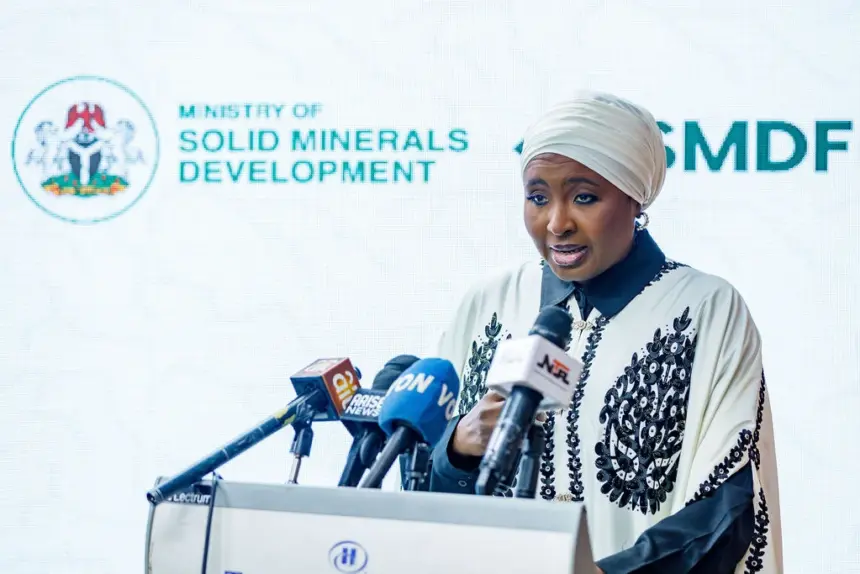
The Executive Secretary and Chief Executive Officer of the Solid Minerals Development Fund, Hajiya Fatima Shinkafi, disclosed the figures. She gave them at the maiden Annual Lecture of the Faculty of Physical and Earth Sciences, University of Lagos.
Shinkafi said the improved performance reflected the impact of reforms introduced under the Federal Government’s plan. The plan aims to raise the solid minerals sector’s contribution to Gross Domestic Product from less than one per cent to three per cent by 2030.
She said the reforms aligned with the Seven-Point Agenda of the Minister of Solid Minerals Development, Dele Alake.
Despite Nigeria’s vast mineral deposits, Shinkafi said the sector still remains underdeveloped. She noted that the country has more than 44 commercially viable minerals in over 500 locations. These include gold, lithium, iron ore, coal, bitumen, barite and gemstones.
“In 2025, solid mineral exports of about N354 billion accounted for roughly 0.4 per cent of Nigeria’s total exports and about three per cent of non-oil exports, compared with nearly five per cent of total exports at independence,” she said.
Shinkafi said the reform agenda, launched in September 2023, focuses on establishing the Nigerian Solid Minerals Corporation. It also aims at attracting private investment, improving geoscience data, formalising artisanal mining and fighting illegal mining through Mining Marshals.
She added that the government has also revoked dormant mining licences. Furthermore, it pushed for local value addition to improve earnings from the sector.
“The same minerals and the same ground are now delivering far greater value because they are being governed differently,” she said.
According to her, the sector recorded 33.5 per cent real growth in 2025. This is far above Nigeria’s overall economic growth of 3.9 per cent.
Shinkafi also disclosed that reforms introduced since 2023 have attracted about $2.6bn in fresh investment commitments.
She said the commitments include a $1.3bn, 1.5-million-tonne alumina refinery. She described it as the largest mining investment in Nigeria’s history.
The Federal Government now targets a 25-fold expansion of the sector to about N30tn, or $21bn, by 2030.
The latest growth in solid minerals exports has strengthened expectations that the sector could become a major source of non-oil revenue. This will happen if reforms continue and investors receive the right support.