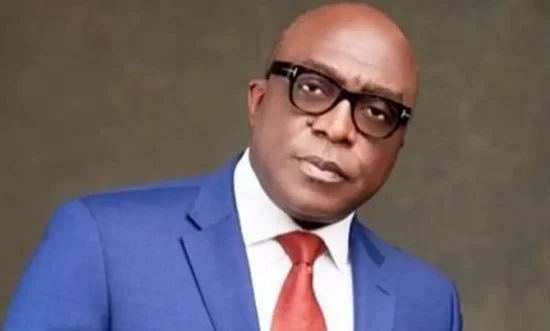
The Chairman and Chief Executive Officer of United Airlines Limited, Prof. Obiora Okonkwo, has said air travel within Nigeria is still among the cheapest in the world, despite growing complaints by passengers over rising ticket prices.
Okonkwo, who also speaks for airline operators in the country, made the claim on Thursday during an interview on Channels Television’s The Morning Brief.
He said Nigerian airlines are under serious financial pressure but have continued to keep fares low when compared with what passengers pay in other countries.
“I think internal air travel within Nigeria is one of the cheapest,” Okonkwo said.
He explained that airlines across the world operate in the same aircraft market and pay similar staff costs, but Nigerian operators face higher expenses due to unfriendly loan terms, multiple taxes and heavy dollar-based costs.
“We know the rates around the world. If you get a ticket for 100 dollars, it must have been discounted, and there must have been someone in that aircraft who also paid 1,000 dollars,” he said.
“We use high ticket prices to compensate for your low ticket prices. And we operate in the same market, buy aircraft from the same market, and pay staff like those airlines operating in other countries.”
Okonkwo noted that almost all aviation expenses in Nigeria, including spare parts, aircraft maintenance and equipment, are paid for in dollars, while tickets are sold in naira.
He added that local airlines also access loans at interest rates of between 30 and 35 per cent, compared with 2 to 7 per cent available to airlines in other countries.
“Our operational costs are enormous. And we here pay a lot of unexplainable taxes that don’t exist in many parts of the world. Still, we charge low,” he said.
“I fly around the world and pay about 1,400 dollars for a 45-minute flight. Multiply that. So, Nigeria remains one of the countries with the cheapest fares, and it is to the detriment of the operators.”
According to him, the high cost of operations has contributed to the collapse of several airlines over the years.
“We have had high mortality rates of airlines in the past few years. Everything has to be done to remove taxes and levies for airlines to be marginally sustained,” he said.
Okonkwo dismissed allegations of price gouging by domestic airlines, saying recent fare increases are mainly due to higher demand during the festive season.
He said similar price spikes happen globally during peak travel periods and even on Nigerian roads.
He also criticised the circulation of what he described as misleading ticket prices on social media.
“I know it has been a hot topic in recent times. But airline operators are not doing anything unusual,” he said.
“What I have seen recently, especially on social media, are the highest ticket category being shopped around.”
He explained that passengers often mistake premium or last-minute tickets for regular economy fares.
“In any aircraft where you see a fare of 400,000 naira, there are also seats where passengers paid 100,000 naira in the same aircraft,” Okonkwo said.
“But at the end of the day, the average may not be more than between 120,000 naira and 150,000 naira. We have six ticket classes, even in economy, and a formula that determines fares.”
While sympathising with Nigerians affected by high fares, he recalled that when tickets sold for between 20,000 and 30,000 naira, the naira exchanged at about 250 naira to the dollar.
“But today, even the highest fee you see is barely 200 dollars,” he said.
“Some of the tickets being sensationalised were not economy tickets. They were either business class or premium economy tickets, possibly bought on the day of travel.”
His comments come as regulators intensify scrutiny of domestic airlines.
Last week, the House of Representatives urged the Federal Government to grant tax waivers to airlines and reduce auxiliary charges by 50 per cent to ease fares during the Yuletide season.
The Senate has also summoned the Minister of Aviation, Festus Keyamo, and other stakeholders over rising ticket prices.
Meanwhile, the Federal Competition and Consumer Protection Commission has expanded its investigation into what it described as suspicious and possibly exploitative airfare increases, especially on South-East and South-South routes.
In a statement issued last Friday, the FCCPC said it is reviewing airlines’ pricing templates and ticketing practices to determine whether the increases breach the Federal Competition and Consumer Protection Act, 2018.
The commission said it is not a price control agency but will act if evidence of anti-competitive or collusive pricing is found.