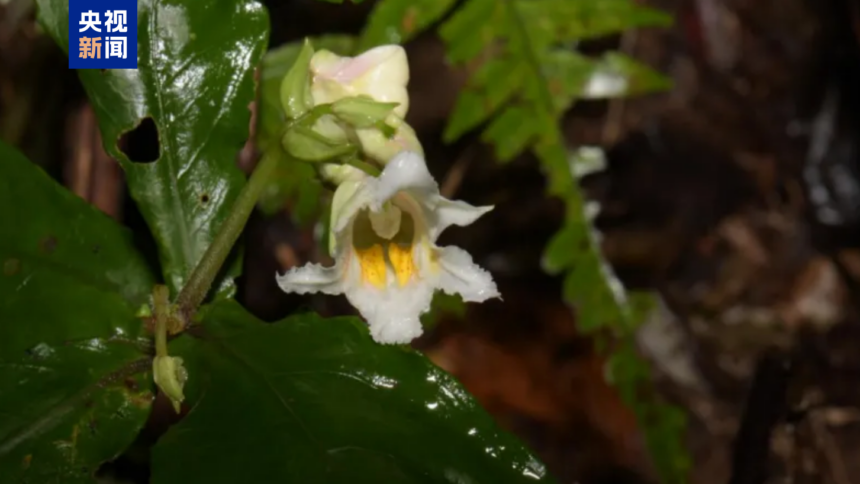
A previously unknown species of Impatiens has been discovered in the Damingshan National Nature Reserve in south China’s Guangxi Zhuang Autonomous Region, providing fresh evidence for research into plant evolution and biodiversity conservation.
The newly identified species, officially named Impatiens shanglinensis, or Shanglin impatiens, was discovered by researchers from Hunan Normal University and the Wuhan Botanical Garden of the Chinese Academy of Sciences.
The team’s findings were recently published in the international journal Plant Systematics and Evolution.
The discovery is notable because the plant belongs to a rare subgenus of Impatiens that occupies a distinctive position in the evolutionary history of the group but contains relatively few known species. The subgenus represents less than 10% of all Impatiens species, while discoveries of new species within the group have become uncommon in recent years.
China has recorded more than 300 native Impatiens species, with about 90% of them found nowhere else in the world.
Researchers came across the previously undocumented wild population in November 2022 while conducting a field survey in the Damingshan reserve. The plants were growing in a well-preserved forest valley at an elevation of 803 meters. Their unusual characteristics led researchers to suspect that they could represent a new species.
The team subsequently conducted a detailed investigation, recording the characteristics of the plants’ stems, leaves, flowers and seed capsules. These features were then compared with those of closely related species, including Impatiens guizhouensis.
Although the two species have several characteristics in common, the researchers found clear morphological differences in Impatiens shanglinensis. These include its overall height, densely fine-haired upper stem, nearly stalkless obovate leaves and distinct floral structures.
Current field surveys indicate that only three wild populations of the newly identified species have been located, comprising an estimated 300 individual plants in total.
The perennial herb blooms and produces fruit from October to November. Researchers also noted that its delicate white flowers could give the species potential value in the development of ornamental plants.
The discovery adds to the known plant diversity of the Damingshan National Nature Reserve while also providing valuable material for studying the evolutionary history of the Impatiens genus. It could further help researchers investigate how the genus originated and diversified across East Asia.