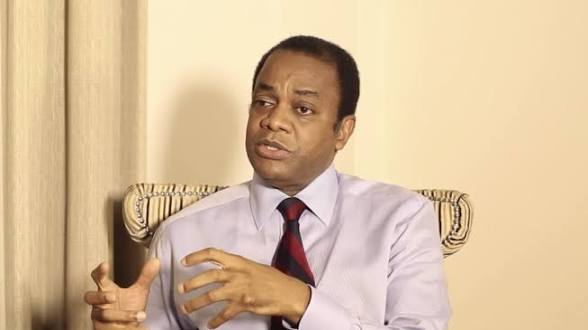
The presidential candidate of the Peoples Redemption Party, Donald Duke, has outlined his proposed approach to governance ahead of the 2027 general election, declaring that his cabinet could be made up entirely of professionals and individuals with proven competence, without necessarily accommodating politicians.
Duke, a former governor of Cross River State, made the disclosure during an interview in Abuja yesterday, stressing that Nigeria’s numerous challenges required a leadership structure driven by expertise, accountability and measurable results rather than political loyalty, patronage or electoral calculations.
He maintained that appointing individuals based on their ability to deliver, rather than their political affiliations, would be a priority in his administration if elected president. “If I am going to pick a cabinet, you may not find any politician in that cabinet,” he said.
The PRP candidate argued that the forthcoming presidential election should focus on the solutions candidates intend to offer to the country’s pressing challenges, including economic instability, insecurity, unemployment, poor educational standards, healthcare deficiencies and weaknesses in the justice system.
According to him, prioritising political interests when constituting a government could undermine effective administration, as officeholders might become more concerned about maintaining political alliances and securing another electoral victory than delivering on their responsibilities.
Explaining his position, Duke said he would rather depend on Nigerians’ approval of his administration’s performance than rely on political structures and influential individuals for electoral support.
“I’m going for broke. When you start putting politicians in your cabinet, you are looking at the next election. You are thinking about the people who will support you. For me, I want the people to support me. If you perform, the people will support you,” he said.
Drawing from his experience as Cross River governor between 1999 and 2007, Duke maintained that effective leadership and tangible achievements could generate sufficient public goodwill to secure electoral support without excessive political mobilisation.
He recalled that his first governorship campaign involved considerable effort to introduce himself to voters and establish his political identity. However, he said his administration’s performance significantly reduced the need for extensive campaigning when he sought re-election.
“My first election in Cross River was really tough. I was basically introducing myself to the people, and there were politicians running around everywhere.
“But by my second election, I hardly needed to go to rallies. You could feel the mood. People would tell me, ‘Don’t worry yourself; you have proved your mettle.’”
The former governor explained that his experience reinforced his belief that elected leaders should be judged primarily by their achievements, particularly when seeking another term in office.
He argued that while first-time candidates largely depend on their promises to convince voters, incumbents should have demonstrable accomplishments to present as evidence of their performance.
“When you prove your mettle, much of the politics disappears. People trust you because they have seen what you can do.
“When you are contesting for the first time, people hold on to your words because that is what you offered them. But when you are seeking a second term, they should hold on to your work. Your work should speak for you,” he said.
Duke expressed concern over political officeholders who, despite spending considerable time in government, still depend heavily on campaign promises and lengthy explanations of their supposed achievements to persuade the electorate.
He insisted that a credible record of governance should be sufficiently visible to citizens without requiring elaborate publicity during election campaigns.
“At that point, you shouldn’t have to spend your time telling people what you did. They should know. Your work becomes your campaign,” he stated.
Beyond the question of cabinet appointments, the PRP presidential hopeful identified what he described as a major deficiency in Nigeria’s democratic system, arguing that the constitutional provisions establishing eligibility for public office do not adequately address the question of leadership suitability.
He noted that meeting requirements relating to age, citizenship and criminal records might make an individual constitutionally qualified to contest an election, but such qualifications do not necessarily demonstrate the person’s ability to govern effectively.
Duke called for the development of a comprehensive framework for assessing the competence and preparedness of individuals seeking positions of political leadership.
“The constitution tells you who is eligible. It tells you the age requirement and says you must not have certain criminal convictions and so on.
“But where is the section dealing with suitability? We need to sit down and design a suitability matrix. Leadership should not be a free-for-all where everybody enters and the most popular person wins, even when that person does not know where he is taking the country.”
To illustrate his argument, Duke compared the process of selecting political leaders to the way football managers assemble their strongest players for important competitions.
He maintained that Nigerians should prioritise the capacity of presidential candidates to deliver results instead of allowing popularity to determine their choices at the polls.
“If you want to win a Premier League match, you put out your best eleven. That is what I am trying to put on the table.
“This is not a popularity contest. You don’t substitute your future for a popular candidate. You look for who is best equipped to do the job,” he said.
Duke further explained that his decision to pursue the presidency was influenced by his dissatisfaction with the country’s direction and his belief that individuals capable of contributing to national development should not remain passive while Nigeria’s challenges continue to deepen.
Although he declined to describe himself as the best person for the position, he said his candidacy was intended to broaden the choices available to Nigerians and introduce a different approach to addressing national problems.
“Am I the best candidate? I cannot say that. The voters will decide who the best is. But I want to put another option on the table because the options we have had have been too narrow and have not adequately addressed the issues,” he stated.
On his proposed policy priorities, the former governor identified education, healthcare, justice and security as critical sectors that would require competent leadership and effective attention under his administration.
He explained that the central responsibility of government should be to improve citizens’ capacity to contribute productively to society, noting that access to education, good health, justice and security were essential components of national development.
“The ultimate function of government is to enhance the productivity of the people.
“Education becomes critical because people need the skills to be productive. Health is critical because they must be healthy enough to use those skills. Justice is fundamental because you cannot have peace without justice. And security, of course, is indispensable.
“The problem today is that everything has become urgent,” he stated.
Duke also criticised what he described as the self-centred disposition of Nigeria’s elite, accusing wealthy and influential citizens of concentrating on their personal welfare and that of their immediate families while paying insufficient attention to the deteriorating conditions of the wider society.
He argued that the security and prosperity of affluent Nigerians could not be guaranteed independently of the wellbeing of the communities in which they lived.
“The Nigerian elite is selfish and self-centred. He thinks that by looking after himself and his immediate family, he is safe. But he is not.
”Enlightened self-interest should make us look beyond ourselves and consider the wider community.”
He further maintained that economic success should not come at the expense of the larger population, warning that extreme inequality and widespread poverty could eventually threaten the safety of even the wealthiest members of society.
“If you want to be the richest man in the community, that is fine. But make sure the other members of that community are not so poor that your wealth itself makes you a target.
“You see successful Nigerians moving around their own country with security and sirens. This is your country. This is your home. Why should you live in fear in your own home and not realise that something is fundamentally wrong?”
Duke’s position underscores his proposed departure from the traditional practice of distributing government appointments along political lines. He maintained that Nigeria’s next administration must place greater emphasis on competence, effective service delivery and the welfare of citizens rather than political rewards and calculations ahead of future elections.