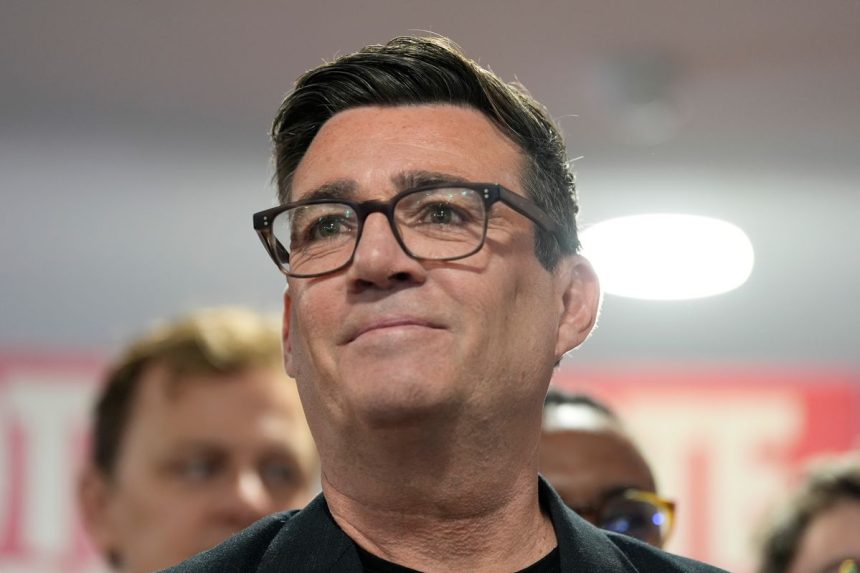
Labour politician Andy Burnham, the mayor of Greater Manchester, has secured a special election victory for a parliamentary seat, placing him in a stronger position as a potential challenger to embattled Prime Minister Keir Starmer for leadership of the country.
Burnham comfortably defeated Rob Kenyon of the anti-immigration Reform UK party in the Makerfield constituency in northwest England, reclaiming a place in Parliament and boosting his profile within the Labour Party.
The result, announced early Friday, reinforces the standing of the 56-year-old politician, widely known as the “King of the North,” as the leading contender to succeed Starmer as Labour leader and prime minister. Burnham received nearly 55% of the 45,510 votes cast, finishing more than 9,000 votes ahead of Kenyon.
In his victory address, Burnham made clear that his ambitions extend beyond simply becoming a Labour lawmaker among the 650 members of the House of Commons.
“Everyone knows that politics isn’t working,” he said. “Everyone can feel that the country isn’t where it should be. Tonight could, just could, be the turning point.”
Starmer, who has repeatedly said he would resist any attempt to remove him as leader, congratulated Burnham through a social media post. “Voters chose Labour’s campaign of hope and optimism over division and hate,” the prime minister wrote on X.
Burnham has served as mayor of Manchester since 2017, overseeing major redevelopment projects in the city associated with the origins of the Industrial Revolution. He has promised to expand his approach, described as “Manchesterism,” across the wider country if given the opportunity.
He said he wanted to make sure that “the name Makerfield is forever synonymous with bringing about the change this country needs.”
The Labour figure also argued that the party had “a final chance to change” and rebuild public confidence.
“But it is a chance now, from this result tonight, to build a new politics based on unity and hope, turning away from the path that takes us to a divided, dark politics of the kind we see in the United States,” he said.
Starmer’s public support has fallen sharply since he led Labour to a decisive election victory in July 2024. His government has faced difficulties in delivering economic improvements, restoring strained public services and reducing pressure from the rising cost of living.
The prime minister has also faced criticism following several political setbacks, including the appointment of Peter Mandelson, whose reputation had been damaged by controversy involving his association with Jeffrey Epstein, as the UK ambassador to the United States.
Labour has seen some progressive voters move toward the expanding Green Party while also dealing with growing pressure from Reform UK, which has frequently performed strongly in national opinion polling. The Nigel Farage-led party has gained support in former industrial areas across northern England, including communities such as Makerfield, located around 200 miles (320 kilometers) northwest of London.
A poor showing for Labour in May’s local elections led a number of lawmakers to call for Starmer to resign. Although he has refused to step aside, senior figures within the party have continued discussions about a possible leadership change.
Former Health Secretary Wes Streeting resigned in May, arguing that “where we need vision, we have a vacuum.” He has also indicated that he would compete in a leadership contest if one is held.
Shortly afterward, Josh Simons, the Labour MP for Makerfield, resigned from his position, triggering the special election that created the opportunity for Burnham to return to Parliament.
The UK parliamentary system allows governing parties to replace leaders during a parliamentary term, with the new leader becoming prime minister without requiring a general election. Under Labour’s rules, a leadership challenge can begin if a candidate secures support from at least one-fifth of the party’s lawmakers in the House of Commons, currently 81 MPs.
Burnham is expected to travel to London to be sworn in as an MP as early as Monday. He is likely to seek discussions with Starmer about a possible transition plan and the timing of any departure.
Culture Secretary Lisa Nandy said Burnham and Starmer would soon need to “have a conversation about what comes next.”
Labour MP Louise Haigh, who supports Burnham, said Starmer should “do what’s best for both the country and the Labour Party” and “consider an orderly and managed transition.”
“Andy won’t be doing anything rash or hasty,” she told Sky News. “I’m really hopeful the prime minister and Andy can come to an agreement.”
Starmer has continued to reject suggestions that he should leave office.
“I will fight if there’s a challenge,” he said at the G7 summit in France this week. “We won a significant general election result in 2024, with a mandate to bring about change. I’m not going to walk away from that.”
The prime minister has suggested Burnham could be offered a senior government position, telling Sky News that “I want him to have a big role in government.” However, Burnham’s allies have indicated that he is not seeking such a role.
Despite Starmer’s determination to remain in power, his position could become vulnerable if Cabinet members withdraw support, resign or publicly pressure him to step aside.
A leadership contest could follow, though some believe the process could effectively become a coronation if Burnham is viewed as having overwhelming support among Labour lawmakers.
Rob Ford, a political science professor at the University of Manchester, said “the pressure on Starmer will be very hard to resist” now that Burnham has returned to Parliament.
Ford said Burnham’s victory over Reform UK strengthens his argument that he is Labour’s strongest political figure.
“The narrative he can bring is, ‘No one else could have won that seat. I won that. I bring something unique. I bring an ability to renew our appeal,’” Ford said.