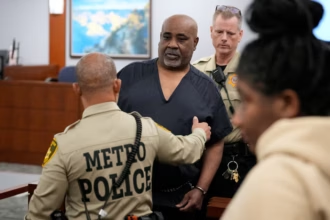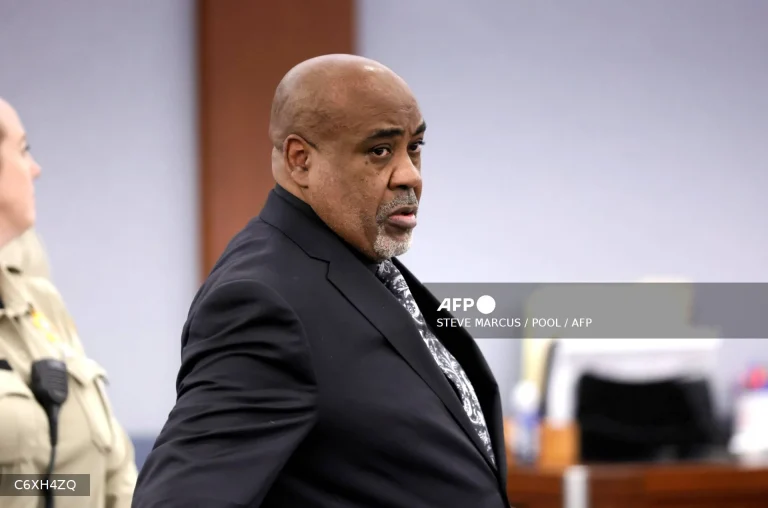
Former gang leader Duane “Keffe D” Davis has been found guilty of orchestrating the 1996 murder of rapper Tupac Shakur. This secured the first conviction in a case that remained unsolved for nearly three decades.
According to BBC, a Las Vegas jury found the 63-year-old guilty of one count of murder with a deadly weapon. They concluded that he helped organise the drive-by shooting that killed Shakur on September 7, 1996.
Keffe D found guilty in Tupac murder
Davis stood quietly in court as the verdict was read before later telling the judge that he intended to appeal.
Shakur’s relatives became emotional as the decision was announced. Some embraced and cried inside the courtroom, while fans gathered outside and reacted with cheers and tears.
The rapper was 25 when he was fatally shot at the height of his career. Since then, he has remained one of the most influential figures in hip-hop.
Prosecutors argued that although Davis did not personally fire the gun, he ordered the attack. In addition, he supplied the weapon used in the shooting.
They said the killing was retaliation after Davis’ nephew, Orlando Anderson, was involved in a confrontation with Shakur. This confrontation involved members of his entourage earlier that night.
Prosecutors rely on Davis’ own statements
A major part of the prosecution’s case centred on Davis’ own public accounts of the events surrounding Shakur’s death.
Over the years, Davis repeatedly acknowledged that he was inside the white Cadillac from which the fatal shots were fired.
He also discussed his role during a confidential 2008 police interview. This interview was connected to the killing of rapper Christopher Wallace, popularly known as Notorious B.I.G.
Davis later provided further details in his 2019 memoir, “Compton Street Legend,” and during several media appearances.
Prosecutors argued that those statements demonstrated his involvement in the attack.
“He’s the shot caller — in every instance in every iteration he’s the leader of the South Side Crips,” prosecutor Binu Palal told the jury during closing arguments.
“When you have the shot caller sitting shotgun when shots are fired, there’s no doubt he’s responsible.”
Defence says claims were fabricated
Davis’ defence team attempted to convince jurors that his previous statements were exaggerated or fabricated. They said his intent was to generate publicity and sell books.
His lawyer, Michael Sanft, urged the jury not to treat Davis’ public comments as reliable evidence.
“There’s no proof,” Sanft told the court.
The defence maintained that prosecutors lacked physical evidence directly linking Davis to the shooting. Therefore, they argued that his previous accounts should not be interpreted as truthful confessions.
The jury rejected those arguments and returned a guilty verdict within hours of beginning deliberations.
Nearly 30-year cold case ends in conviction
Shakur was shot while travelling in a BMW driven by Death Row Records co-founder Marion “Suge” Knight. This happened following a Mike Tyson boxing match in Las Vegas.
A white Cadillac pulled alongside the vehicle at a traffic light before several shots were fired.
Shakur was critically injured and died six days later, while Knight survived his injuries.
The killing became one of America’s most famous cold cases and fuelled years of speculation about who was responsible.
It also occurred during a period of intense rivalry between the East Coast and West Coast rap scenes. There were also gang tensions involving the Bloods and Crips.
Keffe D vows to appeal
Clark County District Court Judge Carli Kierny has scheduled Davis’ sentencing for October 13.
Before the courtroom emptied, Davis raised his hand and told the judge that he wanted to challenge the verdict.
“I would like to appeal this matter,” he said.
The judge explained that the appeal process would take place after sentencing.
The conviction marks the first time anyone has been held criminally responsible for Shakur’s death. This happened nearly 30 years after the killing that shocked the music world.