Israel launched a fresh wave of strikes on Tehran on Monday as Iran threatened retaliation against vital infrastructure across the Middle East, with the conflict now in its fourth week and causing the worst energy crisis in decades.
Explosions rang out in the Iranian capital, local media reported, while Saudi Arabia and the United Arab Emirates said they were intercepting missiles and drones.
At least 40 energy assets across the oil- and gas-exporting region have been “severely or very severely damaged” in the conflict, according to International Energy Agency chief Fatih Birol, as the war ignited by Israel-US attacks on Iran continues.
Birol said 11 million barrels of oil are currently lost per day — more than the daily volume eradicated during two consecutive oil crises in the 1970s.
“No country will be immune to the effects of this crisis if it continues to go in this direction. So there is a need for global efforts,” Birol told journalists in Canberra.
Oil prices rose again early Monday, with US benchmark crude briefly touching the $100-per-barrel mark.
Tehran has responded to assaults by firing missiles and drones at Israel and across the Gulf, hitting energy sites and US embassies. Iran has also throttled traffic in the Strait of Hormuz, through which a fifth of global crude oil transits.
US President Donald Trump threatened to “obliterate” Iranian power plants if Tehran failed to reopen the strait within 48 hours. The deadline, based on the time of his social media posting, would be early Tuesday morning in Iran.
Iran’s parliament speaker, Mohammad Bagher Ghalibaf, responded by vowing that vital infrastructure across the region would “be considered legitimate targets and will be irreversibly destroyed” if Trump carried out his threat.
Iran’s parliament is also considering imposing tolls on shipping through the strait, with Ghalibaf saying maritime traffic would “not return to its pre-war status”.
In Iran, at least 3,230 people have died in the war, including 1,406 civilians, according to the US-based Human Rights Activists News Agency.
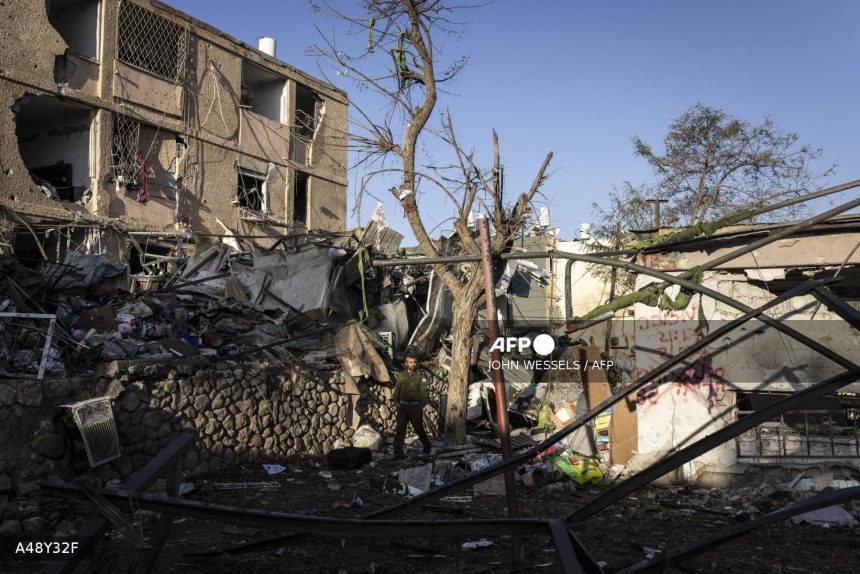
Iranian missiles evaded Israeli defences to land in two southern towns, including Dimona, close to Israel’s desert nuclear facility, injuring dozens on Saturday.
“We thought we were safe,” Galit Amir, a 50-year-old care provider, told AFP in Dimona. “We didn’t expect this.”
Israeli Prime Minister Benjamin Netanyahu has spoken of a long-term campaign against Iran’s government, which backs Hamas and Hezbollah.
Israel has also expanded its ground campaign against Iran-allied Hezbollah in Lebanon. More than 1,000 people have died in Lebanon since Israel launched strikes, according to the health ministry, with over one million people displaced.
Israeli military spokesman Brigadier General Effie Defrin said: “Citizens of Israel, we face more weeks of fighting against Iran and Hezbollah.”
Lebanese President Joseph Aoun warned that attacks on bridges “represent a dangerous escalation and flagrant violation of Lebanon’s sovereignty and are considered a prelude to a ground invasion.”