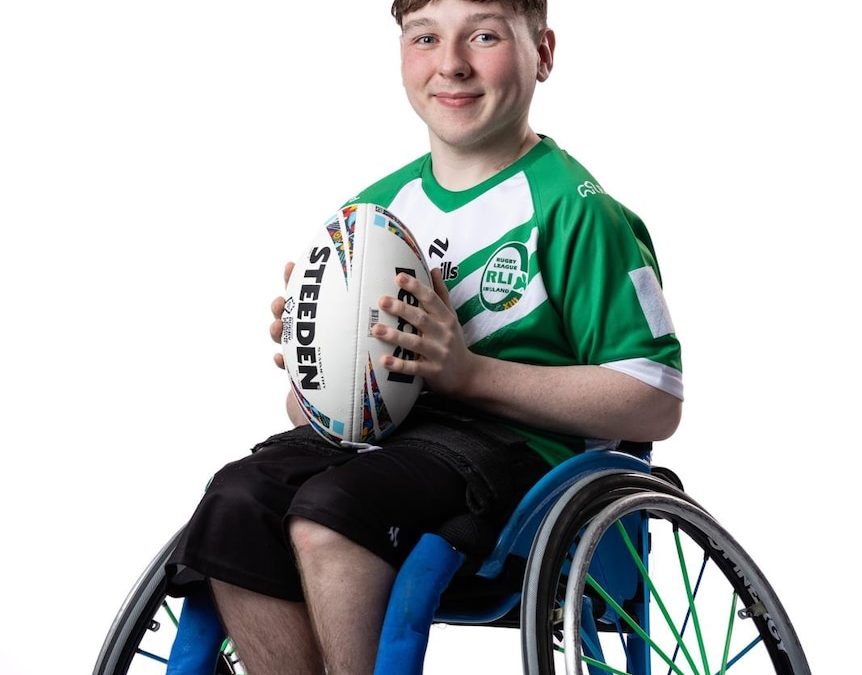
An Irish tourist holidaying in Australia has come to the rescue of a wheelchair rugby league player after helping transport a specially designed replacement wheelchair from Ireland, just in time for him to continue his World Cup campaign.
The 20-year-old Irish international, Oran Spain, was left facing the possibility of missing the Wheelchair Rugby League World Cup after his wheelchair broke during a training session in Wollongong, Australia, where the tournament is taking place.
The situation was particularly challenging because of Spain’s physical build. Being considerably smaller than his teammates, he requires a wheelchair specifically customised to his body. The only available replacement suitable for him was thousands of kilometres away in Ireland.
Spain was diagnosed with XLP, a rare and potentially life-threatening genetic immunodeficiency disorder, when he was just two years old.
Determined not to let the damaged wheelchair end his World Cup ambitions, his family immediately began searching for a way to get the replacement to Australia.
“We knew we had a chair at home so my family went on a mission to see if we could get the chair to Sydney,” team manager and Spain’s mother, Susan Spain, said.
The family’s search for assistance led Spain’s uncle, Austin Smith, to contact RTÉ, Ireland’s national broadcaster, asking for help from anyone travelling to Australia who could carry the wheelchair.
Among those who heard the appeal was Deirdre Donoghue, an Irish woman who was already preparing for a trip to Australia.
Without hesitation, she contacted the radio station and volunteered to transport the equipment.
“I didn’t know if anyone else was going to ring in so I thought I’d ring in and see if I can help out.
“I was coming out anyway to meet my friend who I haven’t seen for 10 years and I heard the request on the radio on Friday and I was heading out Sunday.
“It [the wheelchair] was transferred to all my connecting flights so I didn’t have to think about it — it was grand bringing it over and I thought it was important to bring it over to help out.”
Her willingness to help brought an end to the family’s anxious wait, with Donoghue arriving at Sydney International Airport, where Oran and his mother were waiting to collect the much-needed wheelchair.
For Spain, receiving the replacement meant much more than simply getting back his sporting equipment. It restored his opportunity to represent Ireland on the international stage after years of preparation.
“It’s incredible, this gives me the opportunity to play,” Oran said.
“I’ve been working on this for four years trying to get to a World Cup to be selected — I’ve been flying over to Wigan in England to play every weekend in the summer and now Deirdre’s given me the opportunity to achieve that dream.
“When I was a boy I wanted to play the running game and my only goal was to play for my country, so when I went into the wheelchair that goal shifted a little, but I wouldn’t have it any other way.”
Unlike ordinary wheelchairs, those used in wheelchair rugby league are specially constructed to meet the physical demands of the sport. They are customised to individual players and engineered to withstand high-speed movements and heavy physical contact.
Depending on their specifications, the chairs typically cost between $4,000 and $9,000. Some are considerably more expensive, with Australian wheelchair rugby league captain Bayley McKenna’s equipment reportedly costing $15,000.
Spain explained that the specialised design of his wheelchair made finding a suitable replacement particularly difficult.
“They’re incredibly specialised and my broken wheelchair was tailored to me and this one Deirdre’s brought over is too,” Oran Spain said.
“The wheels are angled, the front bars are rounded for contact and I’m a bit smaller than my teammates, so none of their chairs would work.
“There are not many chairs that would work in the world [for me].”
Following the delivery, Spain was finally able to rejoin his teammates in Wollongong and take part in training with the replacement equipment.
His return came after he missed Ireland’s opening World Cup fixture against the United States last Friday. Ireland won the encounter convincingly, recording a 110-10 victory.
His mother described his return to the competition as an emotional and significant achievement for the entire family, considering the years of dedication that had gone into making his World Cup appearance possible.
“For him to be able to compete and do something he’s been training for and we’ve all been invested in for all these years is huge,” she said.
The family had initially considered repairing Spain’s damaged wheelchair through welding. However, they eventually abandoned the idea because there were concerns that the repair might not withstand the intense physical contact associated with the sport.
As a gesture of appreciation for Donoghue’s extraordinary assistance, the Spain family presented her with match tickets, an official Irish team polo shirt, a hat and a pennant — a traditional item exchanged by competing teams before matches.
Donoghue’s holiday in Australia has now taken on an additional sporting dimension, as she plans to travel to Wollongong to watch the Irish team compete.
“I’ve got the tickets and a jersey now so I’ll have to go and see what it’s like,” she said.
What began as a simple radio appeal in Ireland has ultimately helped keep a young athlete’s four-year World Cup ambition alive, demonstrating how one stranger’s willingness to help can make an extraordinary difference.