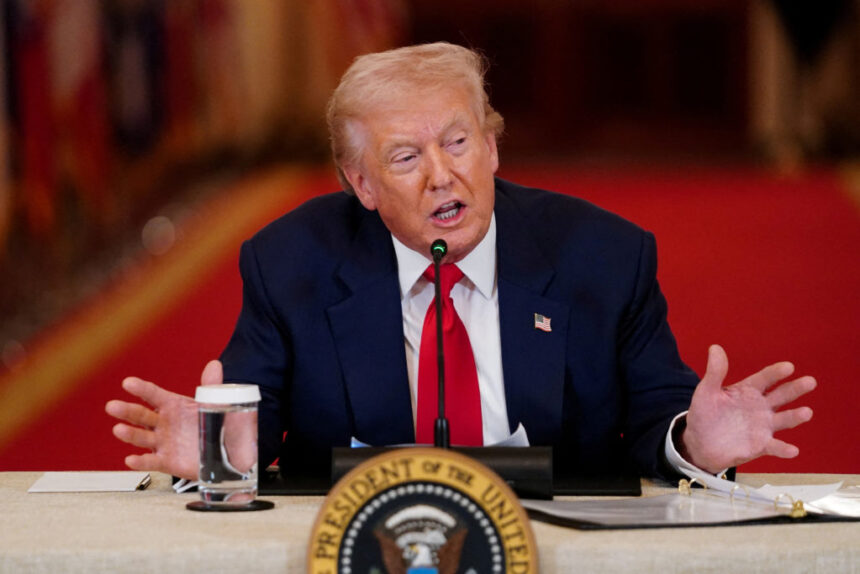
US President Donald Trump has told world leaders that he faces a major decision over whether to pursue peace with Iran. The Trump Iran threat remains a key point as he said he must choose between this or launch further military action against the country.
According to BBC, Trump made the remarks on Tuesday while addressing the United Nations General Assembly in New York. Members of Iran’s delegation walked out during his speech, likely in response to the Trump Iran threat outlined in his remarks.
Trump said Washington could reach an agreement that would allow Iran to rebuild. However, he also threatened stronger military action if efforts to resolve the conflict fail.
“Will a deal be made with Iran that lets them rebuild and create a far greater country than it ever was before?” Trump asked.
“Or do I annihilate the Islamic Republic and do it quickly, never giving them a chance to kill and destroy people and countries again?”
Trump defends war with Iran
Trump spent a large part of his address defending the US-led military campaign against Iran and referencing the ongoing Trump Iran threat.
He argued that the conflict had prevented Tehran from developing a nuclear weapon. This, he said, demonstrated the value of what he described as “peace through strength.”
The US and Israel launched military action against Iran in February. This escalated tensions across the Middle East and contributed to higher global oil prices.
Trump said he still believes Washington can reach an agreement with Tehran. He predicted that progress could come after the US midterm elections in November. Clearly, the Trump Iran threat continues to shape regional dynamics.
The US president also used the speech to promote his administration’s record on the economy, immigration, border security and violent crime.
Trump predicts end to Ukraine war
Trump also expressed confidence that his administration could help end Russia’s war in Ukraine.
“We’re working very closely with the leaders of Russia and Ukraine, and we will get that one done,” he said.
“It’s going to happen, I think, more quickly than people understand.”
However, fighting between Russia and Ukraine has continued, with both countries carrying out missile and drone attacks.
Trump was also scheduled to meet Ukrainian President Volodymyr Zelensky and several other world leaders during the UN gathering.
Trump vows US will lead AI race
Artificial intelligence also featured prominently in Trump’s address.
The president rejected calls for excessive international control of the technology. He said the United States would not surrender its lead to China.
Trump suggested that artificial intelligence should instead be called “super intelligence.”
“The use of the word artificial makes it sound fake,” he said. “It’s not fake, it’s actually amazing. But we have to be careful.”
He also criticised what he called attempts by global institutions to control emerging technology.
US expands military access to Greenland
On the sidelines of the UN General Assembly, Trump signed an agreement with Denmark and Greenland’s leaders. The aim was to increase the US military presence on the island.
The agreement maintains Greenland’s sovereignty while giving Washington wider access to its territory and airspace.
Trump also planned meetings with leaders from Saudi Arabia, Qatar, the United Arab Emirates, Kuwait, Bahrain and Oman.
Trump attacks ‘global government’
Trump used his speech to criticise international institutions and defend national sovereignty.
“There is no global government,” he said.
He accused parts of the United Nations system of promoting what he described as a “far-left agenda of globalist bureaucrats.”
Trump also warned that Washington would use its military strength to defend US interests in the Western Hemisphere if necessary.
His comments contrasted with UN Secretary-General António Guterres, who warned earlier that divisions between countries were widening.
Guterres urged major powers to recognise their dependence on other nations. This, he said, was important as the world faces wars, climate change and rapid developments in artificial intelligence.