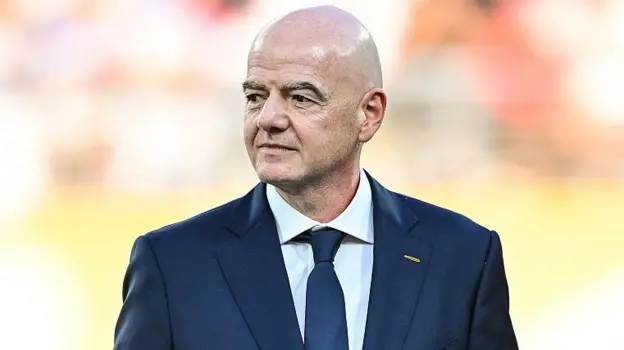
FIFA president Gianni Infantino could face a challenger in next year’s presidential election as opposition to his leadership continues to grow, UEFA president Aleksander Ceferin has warned. This development is raising the prospect of an Infantino re-election challenge looming over the organisation.
According to Reuters, Ceferin ruled himself out of running for the FIFA presidency but said he believes an opposition candidate is likely to emerge if Infantino seeks another term in the March 2027 election, further fuelling speculation about an Infantino re-election challenge.
Ceferin predicts challenger for Infantino
The UEFA president said Infantino now faces a choice between recognising that he has lost significant support within football or proceeding with his re-election campaign against a rival candidate amid mounting talk of an Infantino re-election challenge.
“I think he will have a candidate against him. I don’t know yet who,” Ceferin said.
His comments come amid a widening dispute over Infantino’s leadership following his abandoned proposal to establish a commercial entity for FIFA tournament rights and sell a 20 per cent stake to private investors.
The plan triggered strong opposition from UEFA, the Asian Football Confederation and CONCACAF, which represents North and Central America and the Caribbean.
World Cup sell-off plan fuels crisis
Critics argued that the proposal could have given private investors unprecedented influence over commercial rights connected to competitions including the World Cup. Notably, all of this has unfolded ahead of an anticipated Infantino re-election challenge next year.
Ceferin described the plan as a serious threat to football governance and rejected suggestions that opposition came only from Europe’s wealthiest football nations.
He said smaller associations including San Marino, Cyprus and Liechtenstein had also opposed the proposal.
The controversy has placed Infantino under some of the strongest pressure of his decade-long FIFA presidency.
No-confidence vote under consideration
UEFA, AFC and CONCACAF have also been considering whether to pursue a vote of no confidence in Infantino before the presidential election.
Such a move would represent an extraordinary escalation in the dispute surrounding FIFA’s leadership.
Six Nordic football associations — Denmark, Finland, Iceland, Norway, Sweden and the Faroe Islands — have also publicly called for Infantino to resign and backed demands for changes to FIFA’s governance.
Despite the growing opposition, Infantino has shown no indication that he intends to step aside.
Infantino courts smaller football nations
The FIFA president has instead presented himself as a defender of smaller and less wealthy football associations, arguing that the governing body must reduce the financial gap between powerful football nations and developing ones.
Infantino recently visited the Dominican Republic, where he met members of the Caribbean Football Union and highlighted FIFA-funded development programmes.
The visit went ahead despite CONCACAF president Victor Montagliani previously asking him to stay away from an under-14 tournament because of concerns that the governance controversy would overshadow the competition.
Infantino continues to enjoy significant backing from football associations in Africa and South America, support that could prove crucial if he contests the election.
FIFA battle heads towards 2027 vote
Infantino has served as FIFA president since 2016 and appears determined to secure another mandate that would keep him in office until 2031.
Ceferin, meanwhile, said his decision not to challenge for the position allows him to criticise Infantino without being accused of pursuing the presidency himself.
With regional confederations divided and national football associations beginning to take public positions, attention will now turn to whether a credible candidate emerges before the election.
The growing resistance means Infantino could face one of the toughest political battles of his FIFA presidency when football’s governing body votes for its leader next year.