




The United Nations International Maritime Organization on Thursday suspended its operation to assist ships leaving the Strait of Hormuz after a vessel reported coming under attack, reviving uncertainty over the durability of a preliminary agreement aimed at ending the Iran war.
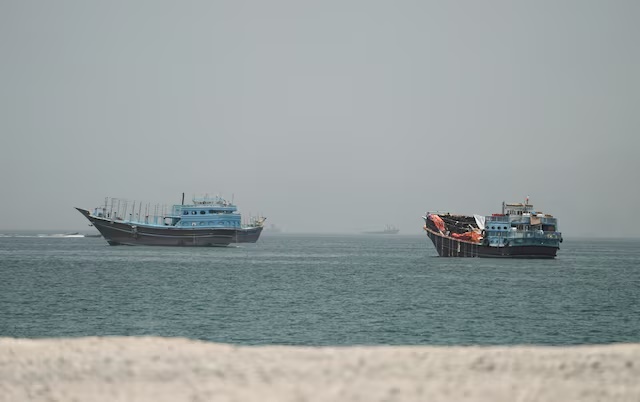
The cargo vessel reported being struck by a projectile near Oman, according to the British maritime security agency UKMTO.
The incident occurred hours after Tehran warned ships against using routes that had not received Iranian approval.
Two US officials told Reuters that Iran was responsible for firing on the vessel. Meanwhile, Iran’s Persian Gulf Strait Authority, a body created by Tehran to oversee ship transit requests through the waterway, warned that vessels outside approved routes would not be assured safe passage.
“Consequences arising from passage through unauthorized routes shall be the responsibility of the owner, operator, and vessel commander,” the Iranian authority said.
Four sources identified the vessel as the Singapore-flagged Ever Lovely, while a security source said the ship was likely targeted by a drone.
The U.S. government did not immediately issue a statement on the incident. Earlier this month, U.S. President Donald Trump warned that if Iran failed to comply with an agreement designed to end the conflict and reopen the strategic waterway, Washington would likely resume airstrikes against the country.
The IMO had been assisting hundreds of stranded vessels and thousands of seafarers trapped in the Strait of Hormuz since the outbreak of the war in late February.
IMO Secretary General Arsenio Dominguez said the agency decided to halt the operation temporarily to verify that adequate safety measures remained available for ships involved in the evacuation effort and other vessels operating in the region.
“It is to temporarily pause its implementation in order to reconfirm that the necessary safety guarantees continue to be in place for the ships on our evacuation list and all those in the region,” Dominguez said in a statement.
The IMO clarified that the vessel involved in the suspected attack was not among the ships included in its evacuation program.
The initiative, launched on Tuesday, allowed vessels and their crews to voluntarily leave the Gulf through two possible routes — one through Iranian waters and another through Omani waters under U.S. monitoring, according to the IMO.
Oil prices climbed about 2% after news of the attack emerged, with analysts warning that the incident renewed concerns over how quickly energy shipments through the Gulf could return to normal.
The attack near Oman is expected to increase scrutiny over Iran’s future influence over the Strait of Hormuz, a crucial maritime passage that before the conflict carried around one-fifth of global daily oil and liquefied natural gas supplies.
Before the incident, U.S. Secretary of State Marco Rubio, during a Gulf tour aimed at reassuring regional partners about the temporary agreement, warned that any Iranian attempt to threaten or restrict shipping through the strait would create a serious dispute.
“If Iran threatens or blocks ships in the strait, then we’re going to have a problem,” Rubio told reporters.
Iran, however, has indicated that it intends to maintain authority over the waterway.
Iran’s Islamic Revolutionary Guard Corps said on Thursday that safe movement through the strait would only be possible along routes approved by Tehran, warning that action would be taken against vessels that ignored the restrictions.
The Revolutionary Guards also instructed two Panama-flagged ships to alter their routes on Thursday, according to British maritime security firm Ambrey.
Earlier, U.S. Energy Secretary Chris Wright said shipping activity through the strait had nearly returned to levels recorded before U.S. and Israeli strikes against Iran on February 28, with at least 20 million barrels of oil moving through the waterway in the previous 24 hours.
Additional shipping data showed crude oil flows through the Strait of Hormuz reached their highest level since the war began in February. South Korea’s Oceans Ministry also reported that eight more South Korean vessels had successfully left the strait.
Throughout the conflict, Iran gained effective control over the strategic passage, disrupting oil exports and increasing pressure on global energy markets and the broader economy.
The war has become a political challenge for Trump ahead of November’s midterm elections, which will determine control of Congress. A Reuters/Ipsos survey found that only one in four Americans believed the conflict was worth the cost.
Uncertainty has continued over several parts of the proposed ceasefire framework, leading to criticism of Trump both domestically and internationally.
Key disagreements remain over financial arrangements for Iran, nuclear monitoring, control of the Strait of Hormuz, and Israel’s separate conflict in Lebanon.
Iran’s lead negotiator, Mohammad Baqer Qalibaf, rejected U.S. claims on Thursday that Tehran would use unfrozen assets to purchase American agricultural goods, calling the statement false.
The agreement includes a 60-day negotiation period intended to address more complex issues, including Iran’s nuclear program.