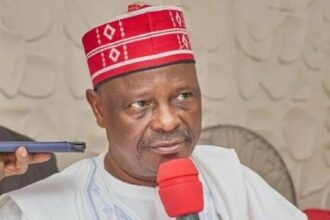
Nigerian singer Adekunle Gold has sparked conversation online after revealing that he does not directly feel the impact of inflation in his daily life.
In an interview clip from The Business Times, the singer explained that he is often unaware when prices of household items increase because he does not personally visit supermarkets or handle routine grocery shopping.
“I don’t feel the inflation going on in the country directly. Until my staff tell me sardines have increased in the market, I’ll be like, ‘Really?’ I wouldn’t know because I don’t go to the supermarket. Or when we buy foodstuff, it’s more often than usual,” he said.
His comments have highlighted how the effects of rising prices can differ depending on an individual’s lifestyle and financial circumstances.
Adekunle Gold’s remarks come as Nigeria’s headline inflation rate eased to 15.39 per cent in August 2026, down from 15.43 per cent in July, according to the National Bureau of Statistics . This marked the third consecutive monthly decline and a significant drop from the 23.14 per cent recorded in August 2025 .
However, economists and analysts have repeatedly cautioned that lower inflation does not mean lower prices. Inflation measures the rate at which prices change, not whether households can afford what they need .
“After several years of high inflation, Nigerians are still living with a much higher price level,” BusinessDay noted in an editorial. “A family whose income has failed to keep pace with the cumulative increase in food, transport, housing and energy costs does not recover its purchasing power simply because inflation falls” .
Food inflation, which matters most to household budgets, stood at 19.57 per cent year-on-year in August, though this was lower than the 25.30 per cent recorded in August 2025 . On a month-on-month basis, food inflation fell sharply to 1.02 per cent from 5.56 per cent in July .
Despite the moderation in inflation figures, the cost-of-living crisis remains severe for millions of Nigerians. A Reuters analysis published in August found that it costs Nigerians more than double to make the staple jollof rice than it did when President Bola Tinubu took office, according to an index by SBM Intelligence .
The World Bank estimates that just over half of Nigeria’s population were in poverty last year, up from roughly 42 per cent in 2022 . Petrol prices are six times higher following the scrapping of the fuel subsidy .
The Minister of Aviation and Aerospace Development, Festus Keyamo, recently said the N70,000 national minimum wage is inadequate to withstand the economic pressures confronting Nigerian workers, noting that the rising cost of living had eroded purchasing power .
Nigeria Labour Congress President Joe Ajaero has called for the use of increased oil revenues to cushion workers and other Nigerians from the impact of rising fuel prices, urging the government to deploy part of the gains to support citizens facing higher transportation and food costs .
Adekunle Gold’s comments have drawn mixed reactions, with some social media users pointing out the disconnect between the experiences of wealthy Nigerians and the realities of ordinary citizens.
The singer, who is married to fellow artiste Simi, has previously spoken about his upbringing and his journey from graphic design to music stardom. He has also been open about his advocacy for sickle cell awareness and his philanthropic work through his foundation.
He has not responded to the criticism that followed his inflation comments as of the time of filing this report.