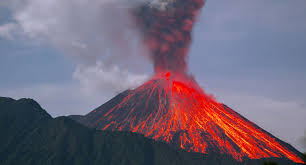
Hundreds of residents living on the slopes of Guatemala’s Fuego volcano in Central America fled their homes on Tuesday after a powerful eruption sent lava cascading down the mountainside and thick ash soaring into the sky.
Authorities declared a red alert—the country’s highest emergency warning level—after the volcano erupted on Monday morning, with volcanic activity becoming more intense by night.
The 3,763-metre (12,346-foot) Fuego volcano, situated less than 100 kilometres from Guatemala City, unleashed streams of lava while towering columns of ash climbed nearly six kilometres into the atmosphere, colouring the sky red.
“Since early morning it was active. That night, the alarm was raised that we needed to evacuate,” local resident Alejandro Garcia, 68, told AFP. Villagers left of their own accord out of fear, Garcia said, describing terrifying scenes of lava oozing down the mountainside.
Emergency responders evacuated at least 500 people from the villages of El Porvenir and Las Lajitas, transporting them to San Juan Alotenango, where temporary shelters have been set up inside a community hall with makeshift beds. Officials have yet to confirm how many other residents have been relocated to surrounding towns.
“If there were any chance of moving to a different house, it would be better, because you’re always afraid since the volcano doesn’t give any warning,” Lidia Ortiz, 40, told AFP at the shelter. Escuintla to the south sheltered dozens more families, including children, local authorities reported.
The red alert covers the departments of Sacatepequez, Chimaltenango and Escuintla, home to an estimated 1.6 million people. Claudine Ogaldes, director of emergency services, urged residents in high-risk communities to relocate voluntarily to designated shelters. “In those spaces, you will find care, support and safe conditions while the volcanic activity continues,” she wrote on X.
Guatemala’s Institute of Volcanology warned that dangerous flows of hot volcanic debris could descend the slopes of Fuego, posing the greatest threat to communities located on its western and southern sides. The institute said the volcano had remained in continuous eruption for about 23 hours by Tuesday morning, although activity had begun to ease slightly.
“We’ve already gotten used to having the volcano constantly active, but this time it was really too much,” 50-year-old resident Sonia Vasquez told AFP.
Authorities reported that operations at Guatemala City’s international airport had not been affected by the eruption. However, in-person classes were suspended in communities across two municipalities near the volcano, while police temporarily shut down a road leading to the colonial city of Antigua before reopening it later in the day.
Located along the Pacific Ring of Fire, Guatemala regularly experiences volcanic eruptions and seismic activity. Fuego has prompted several large-scale evacuations in recent years. More than 500 residents were evacuated last year following emissions of gas and ash, about 1,200 people fled in 2023, and a devastating eruption in 2018 claimed 215 lives, left a similar number missing and buried an entire village under lava.