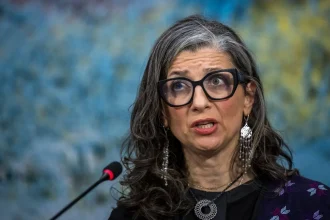
Former Secretary of State, Hillary Clinton, appeared before a Republican-led congressional panel on Thursday investigating disgraced financier Jeffrey Epstein, using the session to challenge President Donald Trump to answer questions about his own past associations with Epstein.
Speaking at the outset of two days of depositions that will also include former President Bill Clinton, Hillary Clinton told lawmakers she had no awareness of any criminal conduct by Epstein or his associate Ghislaine Maxwell.
After more than six hours of closed-door questioning, the deposition concluded late Thursday.
“I had no idea about their criminal activities. I do not recall ever encountering Mr. Epstein,” she said in a statement later posted on social media.
Following her testimony, Clinton expressed confidence that her husband likewise had no knowledge of Epstein’s crimes.
“I never went to his island, I never went to his homes, I never went to his offices,” she said, reiterating that she had no personal ties to the financier.
She also accused the panel of attempting to “protect one public official” — US President Donald Trump.
The proceedings took place in the Clintons’ hometown of Chappaqua after months of disputes between the former Democratic power couple and the Republican-controlled House Oversight Committee.
Lawmakers on the panel are examining Epstein’s network and the extent of his connections with prominent figures.
Bill Clinton is set to testify on Friday, marking what is expected to be the first instance of a former president compelled to provide sworn testimony before Congress.
At one point, the hearing was temporarily halted when an image of Hillary Clinton inside the deposition room surfaced online, in what appeared to be a violation of the agreed closed-door format. “We had agreed upon rules based on the fact it was going to be a closed hearing at their demand, and one of the members violated that rule, which was very upsetting,” she said.
Democratic lawmakers argue that the inquiry is being used to target Trump’s political rivals rather than to pursue legitimate oversight. Recently released government documents tied to Epstein prominently reference both Trump and Bill Clinton, though both men have said they severed ties with Epstein before his 2008 conviction in Florida on sex offense charges.
The Clintons had pushed for their testimony to be conducted publicly, but the committee opted for private depositions. Bill Clinton criticized the approach, likening it to a “kangaroo court.”
While defending transparency in the Epstein matter, some Democrats have also signaled that party loyalty should not shield former leaders from scrutiny. Several Democratic members of the Oversight panel joined Republicans last month in advancing contempt of Congress proceedings against the Clintons.
Representative Robert Garcia, the top Democrat on the panel, echoed calls for Trump’s testimony. He said Bill Clinton’s appearance should establish a standard applied equally to the president.
“Let’s get President Trump in front of our committee to answer the questions that are being asked across this country from survivors,” Garcia said.
Committee Chairman James Comer has previously stated that the panel lacks the authority to depose a sitting president.
Nonetheless, Republicans have focused considerable attention on Bill Clinton’s past interactions with Epstein amid broader political debate over accountability.
Comer emphasized that the investigation seeks clarity about Epstein’s activities and associations. “the purpose of the whole investigation is to try to understand many things about Epstein,” he said, adding after Thursday’s session: “There were a lot of questions that we asked that we weren’t satisfied with the answers that we that we got.”
Bill Clinton has acknowledged traveling multiple times aboard Epstein’s private plane in the early 2000s for humanitarian initiatives connected to the Clinton Foundation, while maintaining that he never visited Epstein’s private Caribbean island.
As Thursday’s proceedings wrapped up, Comer signaled further scrutiny ahead, saying “we have a lot of questions for her husband tomorrow.”
Beyond individual relationships, the committee is also examining why the Department of Justice under earlier administrations did not pursue additional federal charges against Epstein after his 2008 plea agreement in Florida, in which he admitted to state-level charges for soliciting prostitution from a minor and avoided federal prosecution.