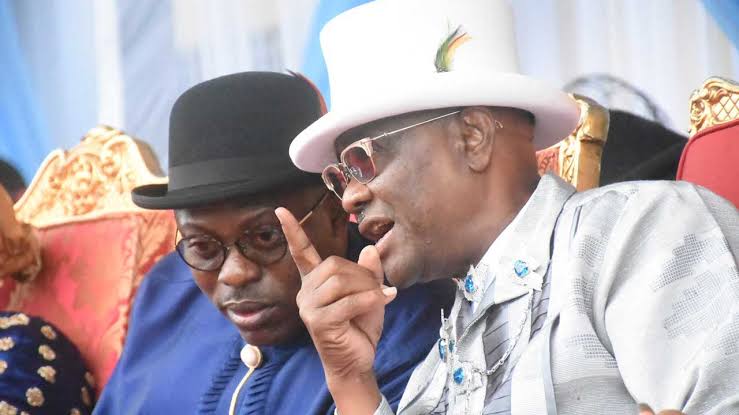
The Minister of the Federal Capital Territory, Mr Nyesom Wike, has dismissed suggestions that Rivers State Governor Siminalayi Fubara has been politically sidelined, insisting that he remains an important member of the political alliance working to sustain the ruling team’s influence in the state.
Wike made the clarification during a media chat in Abuja on Tuesday, where he addressed concerns about the governor’s position within the state’s political structure. He maintained that Fubara’s relatively low public profile should not be interpreted as evidence of his exclusion from ongoing political activities or a breakdown in relations between key stakeholders.
The minister argued that Fubara’s reserved nature was consistent with his personality and did not diminish his involvement in the coalition’s activities. He also disclosed that the governor remained committed to the political arrangements aimed at securing President Bola Tinubu’s re-election in 2027.
“Fubara has not been pushed aside. If you know him, he’s been a very quiet person.
“He is fully a member of the Rainbow Coalition and fully playing his part in efforts to ensure the re-election of President Bola Tinubu in 2027,” he said.
To reinforce his position, Wike pointed to a recent strategic meeting hosted by Fubara at his residence, which brought together prominent political stakeholders. According to the minister, the gathering demonstrated the governor’s continued participation in consultations shaping the political direction of Rivers State.
“Do you know what it takes to hold a meeting in his house? For everybody to be there?
“What matters most to Gov. Fubara is ensuring that his political family retains its influence and power moving forward,” he said.
Wike, who serves as the campaign coordinator in Rivers State, further disclosed that the composition of campaign committees had been finalised and submitted. He indicated that Fubara would occupy a leading position in the campaign structure, further dismissing claims that the governor had lost his place within the political alliance.
Reflecting on the political disagreements that previously strained relationships among prominent figures in Rivers State, the minister accused external interests of attempting to deepen divisions between him and Fubara. He specifically blamed certain opposition governors and individuals he described as ungrateful for exploiting the tensions to advance their own political ambitions.
Despite the earlier disagreements, Wike maintained that forgiveness and reconciliation had helped restore cooperation between the two leaders. He suggested that the resolution of their differences had enabled them to concentrate on preserving their political interests and strengthening the coalition.
The minister also addressed questions about Fubara’s prospects after completing his tenure as governor, including speculation about the possibility of a federal appointment. Although he acknowledged that the authority to nominate ministers did not rest with him, Wike expressed confidence in the governor’s standing within the political arrangement.
He further rejected suggestions that unresolved hostility continued to undermine their relationship, insisting that both leaders were working towards maintaining political stability in Rivers State.
Explaining the composition and purpose of the Rainbow Coalition, Wike said the initiative was designed to bring together politicians from different political parties and interest groups. He noted that the alliance included members of the All Progressives Congress (APC) and other political blocs united by their support for Tinubu and his anticipated re-election campaign.
According to the minister, the coalition was also intended to prevent a recurrence of the protracted legal disputes that had previously disrupted the state’s political environment. He maintained that cooperation among political stakeholders would provide a more effective means of pursuing shared objectives while reducing unnecessary conflict.
Responding to questions about how political offices and electoral tickets would be distributed among members of the coalition, Wike defended the arrangement as a pragmatic approach that accommodates local political realities without compromising the group’s collective objectives.
He explained that coalition membership did not require every participating politician to contest under the same party, stressing that decisions would take into account the political circumstances of individual constituencies while preserving a common commitment to the president.
“When you talk about politicians that agree to form an umbrella, the umbrella does not mean that all the candidates will be one party.
“We look at the peculiarities of areas, and say, listen, all of us are together and all of us are supporters of Mr President,” he said.