


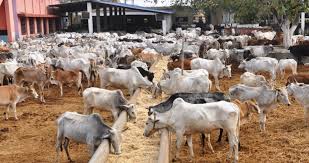
The Federal Government has intensified moves to reposition Nigeria’s livestock sector, identifying it as a strategic driver of economic expansion, food security, and the country’s ambition to achieve a $1 trillion economy.
Minister of Budget and Economic Planning, Abubakar Bagudu, disclosed this in Abuja during a national stakeholders’ roundtable on livestock sector transformation organised by the Abuja Chamber of Commerce and Industry.
Bagudu explained that the government is advancing a comprehensive reform strategy aimed at harmonising policies, strengthening institutions, and attracting private sector investment to maximise the sector’s potential. “The livestock sector is one of Nigeria’s most inclusive and immediately scalable economic opportunities,” he said.
He noted that although livestock activities are widespread across the country, their economic impact has remained limited due to slow adoption of modern techniques and weak coordination among stakeholders. “The sector is present in every state and community, yet its contribution remains low because of slow modernisation and fragmented development efforts,” Bagudu said.
According to the minister, the sector currently accounts for about five per cent of Nigeria’s Gross Domestic Product but holds significant potential for expansion through improved productivity and targeted investments.
He added that the renewed emphasis on livestock development aligns with the economic reform agenda of President Bola Ahmed Tinubu, which seeks to unlock critical sectors of the economy. Bagudu further revealed that the National Economic Council, chaired by Vice President Kashim Shettima, is coordinating efforts across all tiers of government to ensure policy alignment and measurable outcomes.
Highlighting institutional reforms, he said the establishment of the Ministry of Livestock Development is a key step toward accelerating growth by enhancing production, processing, and distribution. “Our objective is to build a modern, competitive and inclusive livestock economy that creates jobs and improves livelihoods,” he said.
Bagudu stated that the government aims to provide a stable and transparent environment to encourage private investment, while also offering support mechanisms to mitigate risks and improve infrastructure.
He noted that funding is being mobilised at federal, state, and local levels to tackle critical challenges, increase productivity, and support smallholder farmers who form a significant portion of the sector.
The minister also pointed to Nigeria’s large population as a ready market for livestock products and a platform for export growth, drawing parallels with countries such as Brazil and Indonesia. “Countries with similar population levels have shown that livestock can significantly increase economic output, and Nigeria has even greater potential,” he said.
Addressing conflicts associated with livestock production, Bagudu identified outdated practices, land pressure, and slow adoption of modern systems as major triggers.
He stressed that embracing modern technology and better resource management would help ease tensions and foster collaboration. “Modernisation is the bridge between conflict and cooperation. By improving systems, we can turn long-standing challenges into economic opportunities,” Bagudu said.
The minister commended the Abuja Chamber of Commerce and Industry for convening stakeholders from government, private sector, and development organisations to deliberate on the sector’s future.
He concluded that with effective coordination, investment, and policy implementation, the livestock sector can meet domestic demand while emerging as a significant source of exports, employment, and national economic growth.


