




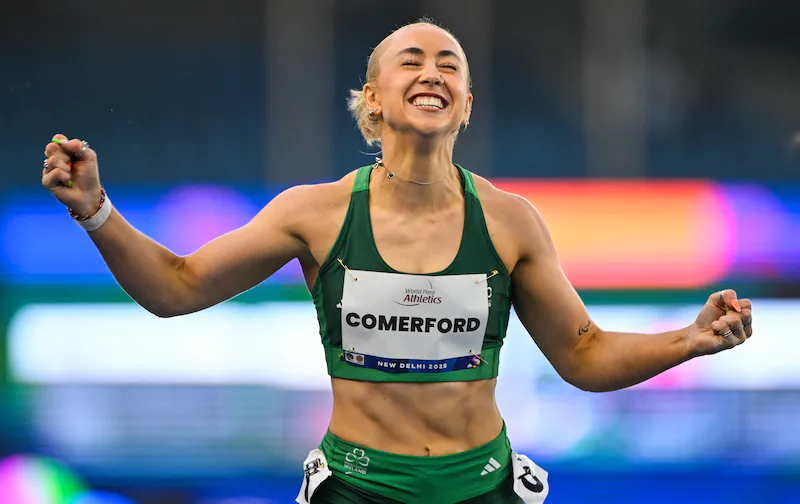
Irish Paralympic sprinter, Orla Comerford, says discipline, rather than motivation, has been the key to sustaining her career as she continues her journey toward the Los Angeles Paralympic Games.
Reflecting on the four-year Paralympic cycle, Comerford said maintaining motivation is not always easy, particularly in the years between major competitions.
With two years having passed since her third Paralympic Games in Paris, she acknowledged that the excitement has faded while the next Games in Los Angeles still feels some distance away.
According to Comerford, athletes cannot rely on a constant source of motivation because it naturally rises and falls over time. She believes that staying committed to established routines is essential during difficult periods, even when training sessions or competitions do not produce the desired results.
“Motivation can set the goal, but discipline achieves it.”
Comerford also welcomed the surge in interest in athletics across Ireland following the Paris Paralympics, saying it has been encouraging to see more children, especially girls, joining local athletics clubs.
Looking back on her own journey, she said the six-year-old who first joined Raheny Shamrocks could never have imagined athletics would become a full-time career. More than two decades later, she has become a double world champion and a Paralympic bronze medallist. Comerford, who has a vision impairment caused by an inherited retinal disease, said visiting her childhood club to inspire young athletes remains one of her proudest experiences.
After major competitions, she said the club regularly invites her to meet its junior members and share her medals. She described those visits as particularly meaningful because they remind her of her own childhood ambitions and demonstrate to young athletes that success is achievable within their own community.
“It’s the proudest day because that was me as a kid, looking up to the older athletes. It’s lovely to have that connection with them – that you’re not just someone on the telly, you’re someone in their community showing that if they want to be an athlete, it’s possible. It’s important to have visibility in sport, but it’s even stronger when it’s in your own community.”
Comerford acknowledged that elite sport also comes with uncertainty, noting that an athlete’s career can end unexpectedly. She credited sports psychologist Jessie Barr, a former Irish Olympian, with helping her appreciate the importance of celebrating achievements instead of constantly focusing on the next goal.
She explained that while striving for higher standards is often what drives elite athletes, it can also prevent them from recognising their progress. Although she considers herself naturally optimistic, Comerford admitted that setbacks are often more common than successes in sport, making it even more important to celebrate every milestone.
“I’m definitely a glass-half-full kind of girl, but the bad days will probably outnumber the good in sport, so to not acknowledge your wins, big or small, is doing yourself a huge disservice. You never know when a personal best, a medal or a race will be your last, so celebrate them.”
While retirement is still some way off, Comerford said she feels at peace with eventually leaving athletics because she has other ambitions she hopes to pursue beyond sport.
She revealed that art has been a lifelong passion, dating back to her school years, and said encouragement from a teacher led her to study at the National College of Art and Design. The experience, she said, played a significant role in shaping her outlook.
Comerford believes art and athletics share more similarities than many people realise. She said both disciplines encourage questioning, reflection and continuous improvement, adding that focusing on the process rather than solely the outcome has strengthened her athletic development.
She noted that although qualifying for the Los Angeles Paralympics remains her ultimate objective, breaking the journey into smaller goals has helped maintain her focus and motivation. According to Comerford, paying attention to incremental improvements eventually leads to greater success.
She added that succeeding in both art and sport requires complete commitment, explaining that athletics remains her full focus because she wants to retire knowing she gave everything possible and helped leave the sport in a stronger position.
Comerford also spoke about the importance of using her profile to advocate for equality and inclusion in sport. She said she feels a responsibility to continue the work started by previous generations of athletes who fought for greater opportunities for para-athletes.
She explained that much of her advocacy centres on campaigning for more inclusive competitions and greater visibility for para sport, adding that she is willing to keep pushing for change so future generations face fewer barriers.
“Because all we ever want as women in sport, as para-athletes, is the opportunity to compete. I don’t want any special treatment; I just want the opportunity to show people what I can do.”
Recalling her first appearance in the Irish vest, Comerford described the moment as the fulfilment of a lifelong dream. She admitted it took several years before she truly believed she belonged among Ireland’s elite athletes and could compete at the highest level rather than simply participate.
She also reflected on periods when injuries and disappointing performances left her feeling she had not represented Ireland as well as she had hoped. In recent years, however, she believes she has finally performed in a way that reflects her potential and honours her family, community and country.
Comerford said setting a new personal best and equalling the European record in recent weeks have strengthened her confidence that she can continue improving. She is now looking forward to competing at the Morton Games in Dublin next week, where she hopes to build on her recent momentum in a strong international mixed-classification para race.
“There’s no feeling quite like representing Ireland. Pulling on the Irish vest gives me an extra edge in those big championship moments. Hearing the crowd, seeing the Irish flags and knowing who you’re racing for is incredibly motivating. It’s something I’ll never take for granted, and it’s a feeling I absolutely love.”