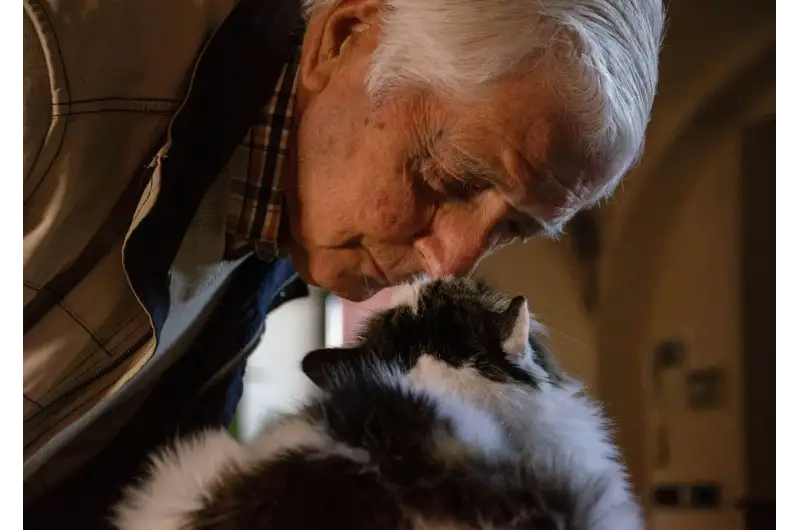
Domestic cats experience aging in ways that closely resemble humans, including similar patterns of brain deterioration, according to a new international study conducted by researchers from the University of Bath in the United Kingdom, Auburn University College of Veterinary Medicine in the United States, and École Nationale Vétérinaire de Toulouse in France.
The findings, published in the journal Biology Open, suggest that pet cats could serve as valuable models for understanding human aging and age-related diseases.
Researchers noted that unlike many laboratory animals, domestic cats live long enough to develop brain changes associated with old age, making them particularly useful for studying the aging process. Their comparatively shorter life spans also allow scientists to observe age-related developments over a much shorter period than in humans.
The study comes as scientists seek alternatives to traditional laboratory research, which often relies on animals with artificially induced diseases and limited life spans. By examining naturally aging cats, researchers believe they can gain more realistic insights into how aging progresses.
Led by Dr. Christine Charvet of Auburn University, the research team, which included Brier Rigby Dames, now a research associate in the Department of Mathematical Sciences at the University of Bath, analyzed 3,754 data points collected from humans, cats, and other mammalian species.
The data encompassed a broad range of indicators, including brain imaging results, blood chemistry, disease-related trends, and developmental milestones such as eye opening and the beginning of playful behavior. The objective was to determine how aging patterns compare across different species.
Magnetic resonance imaging (MRI) findings revealed striking similarities between cats and humans in age-related brain changes. Researchers observed overall brain shrinkage, enlargement of the ventricles—fluid-filled spaces within the brain—and other structural alterations in both species as they age.
These changes are commonly associated with aging-related conditions, including neurodegenerative disorders. The study found that older cats, like humans, can develop neurological changes linked to advancing age.
Reflecting on the findings, Ph.D. candidate Brier Rigby Dames said, “It was interesting to see that cats show patterns of age-related brain atrophy similar to those observed in humans. These findings add to growing evidence that companion animals can provide valuable insights into aging.”
Rather than relying on conventional age-conversion formulas that equate a specific number of cat years to human years, the researchers developed a more advanced biological model. This model was based on measurable age-related changes rather than simple chronological comparisons.
The approach demonstrated that aging does not occur at a uniform pace in either species. Instead, it accelerates and slows during different stages of life, offering a more accurate understanding of biological aging.
Using the model, researchers discovered that aging patterns become especially comparable during later life stages. Their analysis indicated that a cat in its mid-teens is roughly equivalent to a human in their 80s. The study also concluded that while not all animals live long enough to reach the equivalent of advanced human age, domestic cats do.
The researchers believe the findings could have significant implications for both human and veterinary medicine. They are calling for stronger collaboration between the two fields, arguing that such partnerships could accelerate discoveries related to aging, dementia, and overall health in later life.
Study co-author Dr. Ryan Gibson, a veterinary neurologist at Auburn University’s College of Veterinary Medicine, highlighted a growing trend among pet owners seeking advanced brain imaging for their cats. According to Gibson, this expanding access to diagnostic technology presents a unique opportunity to study aging animals that share everyday environments with humans.
He said, “This expanded clinical access creates meaningful opportunities for translational research (research that bridges the gap between scientific findings and health care), improving our understanding of aging and neurologic disease in ways that can benefit both feline and human patients.”
Looking ahead, researchers believe the creation of large-scale veterinary health databases could further advance aging research. Such databases would mirror major human health resources and enable scientists to analyze extensive clinical and owner-reported data across species.
Discussing future possibilities, Rigby Dames said, “There’s potential to develop large-scale veterinary health databases for companion animals, analogous to human health databases such as the UK Biobank. These kinds of resources could enhance our ability to study aging and disease using real-world clinical and owner-reported data collected across species.”
During her Ph.D. studies in the Department of Computer Science at the University of Bath, Rigby Dames contributed to the analysis of thousands of data points spanning the lifetimes of both cats and humans. Her work included examining veterinary clinical records, blood-based aging biomarkers, and neuropathological data to establish age alignments between species, helping researchers better understand how aging unfolds across mammals.