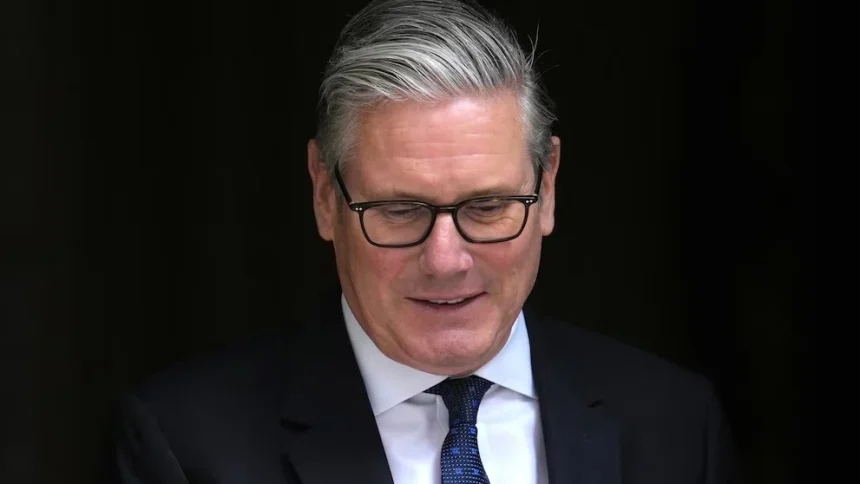
Andy Burnham has emerged as the leading figure to take over the Labour Party leadership and potentially become the next United Kingdom prime minister after Keir Starmer resigned from both roles on Monday, June 22, 2026.
Starmer will remain in office as caretaker prime minister and Labour leader until the party completes the process of selecting his successor.
Burnham’s path to Labour’s top position gained momentum after his victory in the Makerfield parliamentary by-election on June 19, 2026, which provided a platform for his leadership campaign. His rise comes at a critical moment for Labour, following a major setback in local elections where the far-right Reform UK party defeated the party in the same constituency just weeks earlier.
The leadership contest is expected to begin with nominations opening on July 9, 2026, and closing on Sept. 1, 2026, according to The Guardian. Should Burnham face no challenger, he could assume the Labour leadership as early as mid-July.
Former cabinet minister Wes Streeting, who had been viewed as a possible contender before resigning from his government role, has announced that he will support Burnham’s leadership bid.
Under Labour’s election rules, any candidate seeking the leadership must receive endorsements from 20% of Labour MPs, representing 81 lawmakers. They must also secure backing from 5% of constituency parties or 3% of affiliated organisations, including at least two trade unions.
Burnham takes control of Labour after one of the party’s most difficult electoral periods in recent history. The party suffered severe losses in England during the May 2026 local elections and also lost power in Scotland and Wales for the first time since devolved governments were established in 1999.
The incoming Labour leader inherits a party facing pressure over economic concerns, voter dissatisfaction and internal divisions. Burnham’s main political message centres on tackling the cost-of-living crisis through a policy approach known as “Manchester-ism”, which focuses on reducing prices and expanding public ownership. The plan includes nationalising the electricity, gas, water and railway industries.
A three-time elected former mayor of Greater Manchester, Burnham brings extensive government experience to the role. He previously served as Secretary of State for Culture, Media and Sport and later held the health portfolio. His northern identity, Lancashire accent and background have strengthened his connection with white working-class “red wall” voters, a group Labour has struggled to retain.
Burnham’s leadership will also face foreign policy challenges. As a member of Labour Friends of Israel, his position on the Middle East issue could create difficulties in rebuilding support among left-wing and Muslim voters who moved towards the Green Party.
The leadership change marks only the second time in a century that Labour has replaced a sitting prime minister during a parliamentary term. The previous occasion was in 1976, when Harold Wilson stepped down and James Callaghan succeeded him.
The transition adds to a decade of political uncertainty in Britain. The UK will now have its seventh prime minister in ten years, following frequent leadership changes, particularly among the Conservatives, who replaced Stanley Baldwin in 1937, Neville Chamberlain in 1940, Anthony Eden in 1957 and Margaret Thatcher in 1990. More recently, Theresa May, Boris Johnson, Liz Truss and Rishi Sunak served as prime minister between 2016 and 2024.
Burnham’s leadership begins against the backdrop of ongoing economic challenges linked to Brexit. The UK’s departure from the European Union has been associated with an estimated £74 billion reduction in goods exports, a 12% fall in turnover and the loss of around 16,000 British firms exporting to the EU. Research from Stanford University and the London School of Economics has suggested that UK GDP per capita is 6% to 8% lower because of Brexit.
With a possible trade realignment summit scheduled for next month, Burnham’s government will face immediate questions over Britain’s economic direction and its future relationship with Europe.