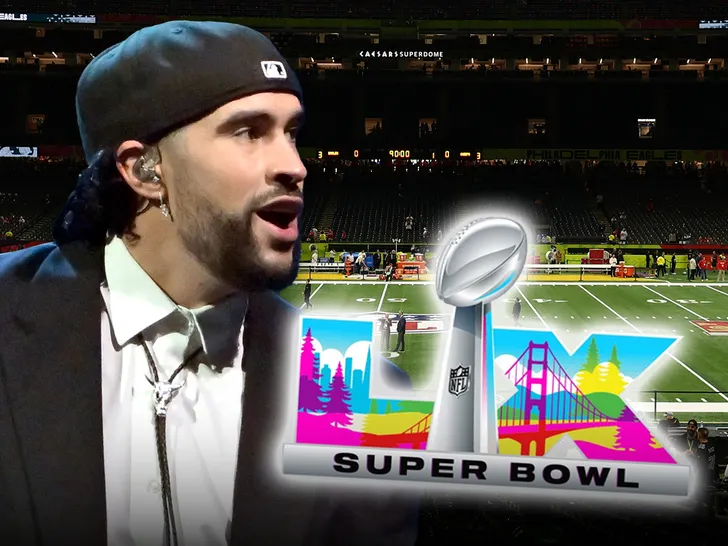
Puerto Rican global star, Bad Bunny, transformed the Super Bowl on Sunday into a vibrant celebration of culture and community, favoring messages of togetherness over division in a historic Spanish-language performance that nonetheless drew sharp criticism from President Donald Trump.
Expectations were intense ahead of the 31-year-old artist’s appearance, with widespread speculation that he might use the massive stage to once again condemn the Trump administration’s hardline immigration policies before a global audience.
Instead, the artist — born Benito Antonio Martinez Ocasio — followed through on his pre-show pledge to spotlight Puerto Rican culture, opting for joyful expression and visual symbolism rather than direct political commentary.
The set was designed as a colorful street scene, complete with a sugar cane plantation, a traditional “piragua” cart, and a staged wedding.
He launched the performance with “Titi Me Pregunto” and the feminist anthem “Yo Perreo Sola,” as a large ensemble of dancers amplified the festive mood.
Actors Pedro Pascal and Jessica Alba, along with rapper Cardi B, appeared as surprise guests, joining the celebration inside the familiar “La Casita” set, which evoked a traditional Puerto Rican home.
Bad Bunny appeared in an all-white outfit, accented by a football jersey bearing the number “64” and the name “Ocasio,” before later changing into a tailored suit jacket.
The tone shifted slightly during “El Apagon” (“Blackout”), a song that addresses displacement on the island and ongoing failures of Puerto Rico’s electrical grid. At one point, the performer waved a Puerto Rican flag.
Another segment featured a young boy watching the Grammys on an old television. Bad Bunny — who won Album of the Year just a week earlier — handed the child a golden gramophone, suggesting a symbolic exchange between generations.
Online speculation quickly erupted, falsely claiming the child was Liam Conejo Ramos, a five-year-old Ecuadoran boy reportedly detained by U.S. immigration authorities in Minnesota.
An NFL spokesperson later confirmed to AFP that the child was an actor, and an Instagram account appearing to belong to the boy, identified as Lincoln Fox, included the hashtag #youngbadbunny.
Additional surprise appearances included Lady Gaga, who performed a Latin-inspired version of her song “Die with a Smile” — the show’s only English lyrics — and fellow Puerto Rican icon Ricky Martin.
Just days earlier at the Grammys, Bad Bunny had openly criticized Trump’s immigration policies, earning applause for declaring “ICE out” during his acceptance speech.
On Sunday, however, he avoided naming the Republican president directly.
The performance concluded with Bad Bunny listing Latin American nations alongside Puerto Rico, the United States and Canada, before spiking a football emblazoned with the words, “Together, we are America.”
A massive stadium screen reinforced the message, displaying the phrase: “The only thing more powerful than hate is love.”
Despite the unifying tone, Trump quickly lashed out, saying: “Nobody understands a word this guy is saying” — a remark made despite official data showing that more than 41 million Americans speak Spanish.
Writing on his Truth Social platform, Trump described the show as “an affront to the Greatness of America.”
Bad Bunny remains one of the most dominant figures in global music, having been Spotify’s most-streamed artist worldwide four times, including last year, and earning a Grammy for Album of the Year with “Debi Tirar Mas Fotos,” the first Spanish-language album to receive the honor.
Nevertheless, his selection as a Super Bowl headliner in California sparked backlash in conservative circles, particularly over his decision not to perform in English.
The NFL partnered in 2019 with Roc Nation, Jay-Z’s entertainment company, to oversee its live music strategy.
Since then, performers such as Jennifer Lopez and Shakira — who previously featured Bad Bunny as a guest — have headlined the halftime show, though neither delivered an entirely Spanish-language set, a milestone Bad Bunny ultimately set.
Raised in Vega Baja, a small town near San Juan, Bad Bunny’s journey to stardom began far from the spotlight.
He was working as a grocery store bagger when a record label contacted him after his songs gained traction on the DIY platform SoundCloud.
That moment marked the beginning of his rapid ascent to the top tier of international music.
Late last year, he released “Debi Tirar Mas Fotos,” an album rooted in Puerto Rican musical history, which he promoted through a concert residency in San Juan followed by a global tour.
Back home in Puerto Rico — a U.S. territory since 1898 — the reaction was overwhelmingly positive.
“For someone from here to be at one of the most important events in the United States is a source of pride for every Puerto Rican,” said Olvin Reyes, 39, speaking to AFP.