

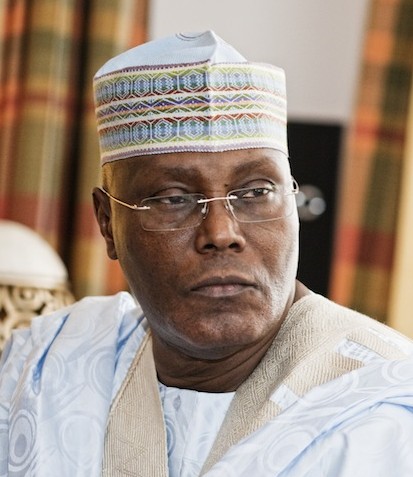
Former Vice President, Atiku Abubakar, has accused ex-President Olusegun Obasanjo of allegedly waging a prolonged “campaign of lies, political manipulation and orchestrated deceit” against him spanning more than 20 years.
Atiku, the presidential candidate of the African Democratic Congress, made the allegation through his Media Adviser, Paul Ibe, in a statement issued in Abuja on Sunday.
The statement was released in reaction to recent remarks by Obasanjo concerning political developments during the 1999–2007 administration.
Ibe alleged that Obasanjo had consistently revived allegations of corruption, betrayal and political disloyalty against Atiku whenever election periods approached.
According to the statement, the latest dispute stemmed from a July 23 claim by Obasanjo that Atiku had encouraged the late former Speaker of the House of Representatives, Ghali Umar Na’Abba, to initiate moves to remove him from office while they served together.
Ibe rejected the claim, describing it as unfounded and noting that Na’Abba, who died almost three years ago, was no longer alive to respond to the allegation.
He pointed to former House Chief Whip Abubakar Bawa Bwari, whom he described as an important participant in the political events of that period, as contradicting Obasanjo’s version of events. Ibe said Bwari maintained that Na’Abba never attempted to remove Obasanjo and that Atiku had, rather, served as Obasanjo’s representative in engagements with lawmakers.
The statement also disputed narratives surrounding the relationship between Obasanjo and Atiku during the 2003 presidential election.
Ibe referred to a video in which former Abia State Governor Orji Kalu was said to have recalled an incident where Atiku knelt before a group of Peoples Democratic Party governors and appealed to them to back Obasanjo’s bid for a second term.
“Atiku knelt down, we were like 17 governors. He knelt down for us and said that he does not want to be disloyal to Obasanjo. That four years is like four days,” Kalu was quoted as saying.
Ibe further quoted Kalu as saying the governors had contemplated actions that could have paved the way for Atiku to become president, but that the then vice president rejected the option because of his loyalty to Obasanjo.
“Atiku was almost a President,” Kalu was quoted as saying, adding that Atiku had declined to turn against Obasanjo despite the political advantage that could have accrued to him.
The statement also revisited the controversy surrounding the Petroleum Technology Development Fund (PTDF) and allegations levelled against Atiku in the build-up to the 2007 presidential election.
Ibe claimed that Atiku temporarily waived his constitutional immunity to subject himself to investigation, insisting that the PTDF funds under scrutiny had been placed in fixed deposit accounts. He maintained that the investigation was driven by political considerations.
He connected the episode to what he described as Obasanjo’s efforts to undermine Atiku’s presidential aspirations and prevent opposition to the proposed constitutional amendment popularly referred to as the Third Term agenda.
In support of his claims, Ibe cited Awujale, the autobiography of the late Awujale of Ijebuland, Oba Sikiru Kayode Adetona.
According to the statement, Oba Adetona documented the 2006 arrest and interrogation of businessman Mike Adenuga by the Economic and Financial Crimes Commission (EFCC), alleging that the investigation was linked to attempts to implicate Atiku in the PTDF controversy.
Ibe also cited Oba Adetona’s account that Adenuga was eventually released and that Obasanjo later approached him over construction work at Bells University in Ota, an institution founded by the former president.
The statement alleged that Adenuga subsequently went into exile during the EFCC investigation but returned to Nigeria after Obasanjo left office. It further claimed that construction activities at the university had slowed during his absence.
Ibe said the account raised questions about the political interests that may have influenced the investigation of Adenuga and the allegations surrounding Atiku.
He maintained that the various accounts and historical records were increasingly exposing what he described as contradictions in Obasanjo’s longstanding allegations against Atiku.
“Finally, former President Olusegun Obasanjo’s campaign of lies, political manipulation and orchestrated deceit stacked against Atiku Abubakar for over 20 years, for political expediency, is falling apart like a pack of cards,” Ibe said.