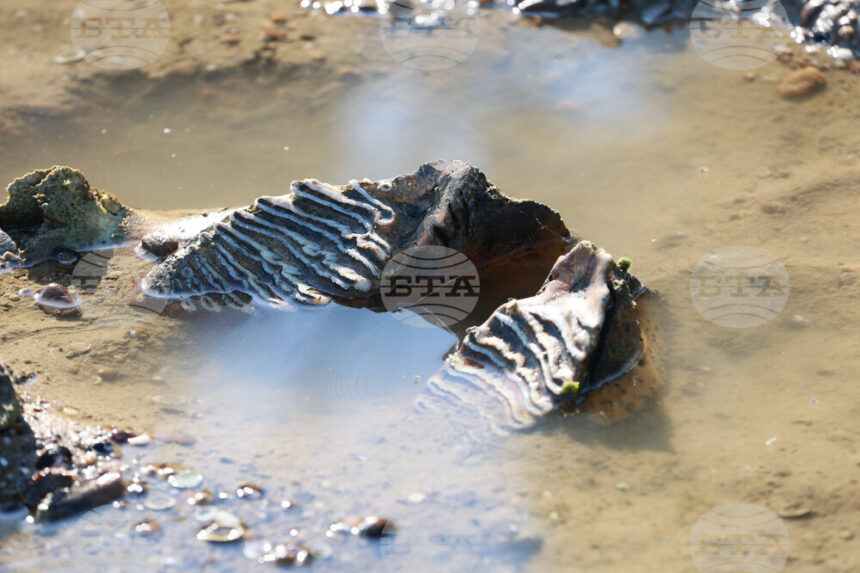
Experts from the Regional History Museum in Ruse on Thursday began recovering and transporting ancient mammoth remains discovered along the Danube River near the village of Ryahovo in Bulgaria’s Ruse Region.
The rare find was exposed after the river’s water level dropped significantly.
Once the excavation is completed, the fossils will undergo conservation and scientific examination at the museum.
The discovery came after a local resident reported unusual bones to authorities, providing photographs that prompted further investigation. Municipal environmental officials and specialists from the Regional History Museum inspected the site on Wednesday.
Ryahovo Mayor Hristina Ivanova described the location as an area of considerable archaeological and historical significance.
“Over the years, various finds have been discovered here, including animal remains, vessels and other objects,” she said.
“The news spread very quickly. At first, we did not want to raise unnecessary expectations before we were certain about what exactly had been found. After the specialists carried out their initial inspection, the information quickly reached the media. Now the entire village knows about it — and, in this case, so does all of Bulgaria,” Ivanova said.
Museum specialists began field operations on Thursday to carefully recover the fossils. Krasimir Kirov, curator of the museum’s Nature Department, said one possibility is that the remains were deposited there by the Danube over time.
“The area near Ryahovo probably represents a kind of deposit where the flow of the Danube carried and accumulated the remains of various animals, not only mammoths. The characteristics of the terrain probably led to their accumulation here, creating sort of a ‘storage bank’. Of course, it is also possible that some of the remains belonged to animals that lived in this area,” Kirov explained.
Researchers currently believe the remains most likely belonged to a woolly mammoth (Mammuthus primigenius).
“The animal was impressive in size – it reached nearly five metres in height and weighed more than seven to eight tonnes. A model of the same species can be seen at the Eco Museum with Aquarium at the Regional History Museum in Ruse, where visitors can get an idea of its scale,” Kirov said.
So far, experts have recovered a lower jaw, tusks, a shoulder blade, ribs and several other bone fragments. They believe much of the skeleton could still remain buried beneath the ground.
“Dating the animal is difficult, but the species we believe this to be existed until around 7,000 to 10,000 years ago and appeared approximately 500,000 to 800,000 years ago. It was a widespread species that lived in a climate radically different from today’s — significantly colder,” the expert said.
Kirov explained that the fossils are fragile because prolonged exposure to water causes them to deteriorate rapidly once they come into contact with air. As a result, the recovery effort is being conducted with great care to ensure the remains can be safely transported and preserved.
“There is another interesting feature. The colour of the bones can provide information. If they are very dark, almost black or dark brown, this often suggests that the animal died in a swampy environment. We are talking about events that occurred thousands of years ago, and the colouring is due to the effect of the mud. We have observed similar features in other fossils found in the area. For now, however, this remains a working theory,” Kirov added.
Earlier, Regional History Museum Director Prof. Nikolay Nenov told BTA that residents had first alerted authorities to the discovery. Initial assessments by specialists from the museum’s Eco Museum identified a mammoth’s lower jaw, two tusks and what was believed to be a rib.
Nenov said preliminary findings suggest the remains may not have been transported by the river. Similar fossils have previously been recovered from river sediments using dredging equipment, but unlike those discoveries, the current remains were concentrated in a single location, raising the possibility that the mammoth died there.
Scientists have long suspected that the area could contain prehistoric remains. One theory suggests the site was once a swamp where the animal perished thousands of years ago.
After conservation and scientific analysis are completed, the fossils are expected to be exhibited at the Eco Museum with Aquarium at the Regional History Museum in Ruse, provided their condition is suitable for public display.
Kirov also highlighted another remarkable feature of the region, noting that fossilized trees dating back several million years have also been discovered there.
“We most often find fragments of palms and other species associated with swamp ecosystems, but not entire trunks. They are very distinctive — it is easy to mistake them for ordinary stones. We once had a case in which a company involved in dredging operations used a similar fossilized tree to prop open a door, without realizing what it was. It eventually became part of the museum’s collection,” the specialist said.