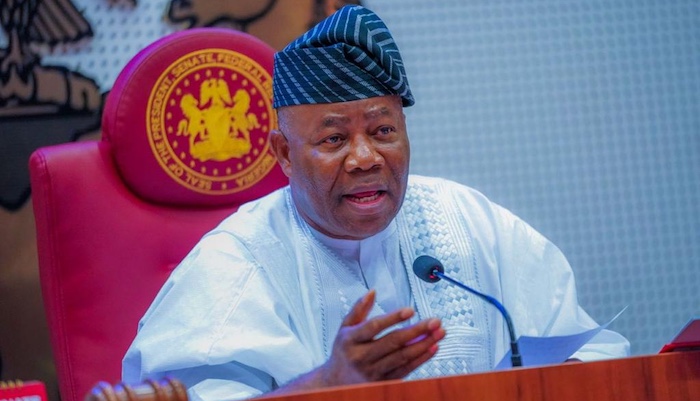
Senate President, Godswill Akpabio, has demanded that former Rivers State Governor, Rotimi Amaechi, present verifiable documents to substantiate his allegation that he introduced a 50 per cent deduction from payments due to contractors executing projects for the Niger Delta Development Commission.
Akpabio’s position was contained in a statement released on Sunday in Abuja by his Special Adviser on Media and Publicity, Eseme Eyiboh, who said the former governor had yet to provide documentary evidence to support the claim.
Describing the allegation as serious, the Senate President questioned the absence of contract agreements, payment records and specific transaction details that could establish whether the alleged deductions occurred and link him to the practice.
Amaechi, a former Minister of Transportation and vice-presidential candidate of the African Democratic Congress, had made the accusation while addressing party supporters during an ADC campaign rally at the Tafawa Balewa Stadium in Bauchi State on Saturday.
Responding to the allegation, Akpabio challenged the former governor to disclose the identities of the contractors allegedly affected, the projects involved, the dates the deductions were made and the payment arrangements through which the purported practice was implemented. He also demanded concrete evidence establishing his personal involvement.
He said, “An allegation delivered before an enthusiastic political audience does not, by that circumstance alone, acquire the status of an established fact.”
Akpabio maintained that any genuine concerns about financial dealings involving the NDDC should be directed to the relevant investigative institutions, insisting that public accusations should be supported by verifiable facts rather than used as instruments of political confrontation.
He urged Amaechi to make available any credible information in his possession and allow the appropriate authorities to investigate the matter.
“If Amaechi possesses credible evidence of unlawful deductions involving NDDC contractors, the appropriate course is to identify the relevant transactions, disclose the supporting records and submit the material to competent investigative authorities and not the act of rabble-rousing,” he said.
The Senate President also questioned aspects of Amaechi’s eight-year tenure as governor of Rivers State between 2007 and 2015, arguing that his administration’s projects and expenditure should equally be subjected to public scrutiny.
Among the projects he highlighted was the Port Harcourt monorail, which attracted public criticism over its reported financial cost, incomplete execution and failure to provide the expected transportation services. He also referenced the Malaria-free Rivers State initiative, raising questions about public expenditure and the actual benefits delivered by the programme.
Akpabio argued that an assessment of such projects should go beyond their announcement or initial implementation to examine the funds committed, the level of completion, the extent to which their intended objectives were achieved and the contractual or administrative decisions that shaped their outcomes.
“Public accountability does not begin and end with one’s political opponents. It extends to every public official entrusted with resources, authority and responsibility,” he stated.
He further cautioned against allowing political activities ahead of the 2027 general elections to encourage allegations that have not been backed by credible evidence. According to him, financial and administrative concerns surrounding the NDDC should be addressed through transparent and impartial investigations.
Established to tackle developmental challenges in the oil-producing Niger Delta, the commission has a mandate that includes addressing infrastructure deficits and environmental concerns affecting communities across the region.
Akpabio stressed that the welfare and development of residents in the Niger Delta must remain the primary consideration in discussions about the commission’s operations. He called for transparent procurement procedures, effective project execution and measurable improvements in the living conditions of communities within its mandate.
He acknowledged Amaechi’s right to question public officials and raise concerns about governance but insisted that such interventions must be accompanied by evidence capable of establishing the claims being made.
“The credibility of a public allegation must rest not on the volume of its delivery, the status of its author or the occasion on which it is made, but on the quality of the evidence supporting it. Let the facts speak,” he added.