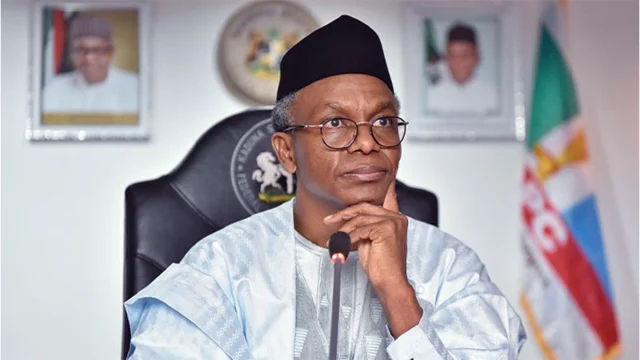
Detained former Kaduna State Governor, Nasir El-Rufai, on Wednesday admitted that his claim that the phone of the National Security Adviser, Nuhu Ribadu, was tapped was untrue, explaining that he made the allegation as political rhetoric to unsettle the government.
El-Rufai, who made the clarification before the Federal High Court in Abuja, said he never intended his statement to be understood literally, insisting that it was designed to create the impression that opposition figures were also monitoring activities within the government, just as he alleged that the government was surveilling prominent opposition leaders.
The former governor stated that although he was aware of alleged surveillance activities targeting opposition figures, former presidents and senior judicial officers, his assertion that Ribadu’s telephone conversations were intercepted was not based on an actual phone-tapping operation.
He made the disclosure while testifying as the first defence witness in his ongoing trial instituted by the Department of State Services (DSS) over allegations bordering on the unlawful interception of Ribadu’s telephone conversations and other offences.
During Wednesday’s proceedings, his counsel, Paul Erokoro (SAN), played an excerpt from an interview El-Rufai granted Arise Television on February 13, in which he had claimed that the NSA’s telephone conversations were being monitored.
Following the playback, Erokoro asked his client to explain the circumstances surrounding the statement and what he intended to communicate. In response, El-Rufai acknowledged making the claim that they were listening to conversations involving the NSA and other government officials, adding that someone had tapped Ribadu’s phone and passed the information to them.
However, he maintained that the statement was not a factual account of any interception but an expression he deployed in a political context, describing it as “the context of literal flourish and in rhetorical form.” He further argued that such expressions were permissible within political discourse.
El-Rufai said: “What I wanted to say was that the government was monitoring opposition figures and that we knew what they were doing.
“I used the word ‘tap’ as political rhetoric to make them uncomfortable. It was rhetorical, not literal. It was linguistic flourish, just to make the government uncomfortable.”
When his lawyer drew his attention to the fact that the interviewer had cautioned him that tapping another person’s telephone was illegal, the former governor explained that his intention was to expose what he described as the government’s alleged unlawful monitoring of opposition figures without obtaining the requisite court authorisation.
He said “I was referring to the government violating the law and not someone else doing it.”
Asked to identify the individuals he included in his use of the pronoun “we” when he claimed that they were listening to conversations involving government officials, El-Rufai explained that he was referring to himself and other prominent opposition figures.
He further denied that he or any member of the opposition intercepted Ribadu’s telephone conversations, claiming instead that information about an alleged plan to abduct and detain him was passed to him by a mutual acquaintance. He declined to identify the individual, explaining that revealing the person’s identity could compromise the source’s interests.
According to him, the acquaintance approached him after he returned home from the television interview and clarified that he had not tapped the NSA’s telephone. El-Rufai said he acknowledged this but explained that he had deliberately made the assertion to make government officials uncomfortable.
Earlier in his testimony, the former governor told the court that his relationship with Ribadu dated back to 2003, when he was heading the Bureau of Public Enterprises (BPE). He said he assisted Ribadu in establishing the Economic and Financial Crimes Commission (EFCC) by providing office accommodation and financial support.
He attributed the deterioration in their relationship to the 2011 presidential election, when Ribadu contested for the presidency and he opted to support Muhammadu Buhari, whom he considered a more suitable candidate.
El-Rufai also alleged that Ribadu’s hostility towards him was connected to his opposition to President Bola Tinubu’s bid for re-election.
The former governor maintained that he had never engaged in telephone interception, insisting that he neither possessed the technical knowledge nor the equipment required to carry out such an operation.
However, during cross-examination by the prosecution counsel, Oluwole Aladedoye (SAN), El-Rufai, who disclosed that he holds a Law degree from the University of London, maintained his decision not to reveal the identities of those he referred to as “we” in his controversial television interview.
He equally refused to disclose the identity of the individual who allegedly informed him that Ribadu, Kaduna State Governor Uba Sani and the Chairman of the Independent Corrupt Practices and Other Related Offences Commission (ICPC) had met and agreed to facilitate his arrest.
The former governor told the court that he became aware of the alleged arrangement to arrest him before travelling back from Cairo on February 12. He explained that he resisted attempts by DSS operatives to take him into custody at the airport upon his arrival because, according to him, they failed to present a valid arrest warrant.
Addressing other allegations he made during the Arise Television interview, El-Rufai insisted that his statements concerning his public financial record and the disappearance of activist Dadiyata while he was governor of Kaduna State were accurate.
He maintained that he had never stolen public funds and denied having any knowledge of the circumstances surrounding Dadiyata’s disappearance. He reiterated that all his other statements during the interview were factual, except the claim concerning the alleged interception of Ribadu’s telephone conversations.
The former governor also informed the court that he had instituted fundamental rights enforcement suits challenging the alleged search of his residence, which he claimed was conducted with a defective warrant. He, however, acknowledged during cross-examination that both the High Court of the Federal Capital Territory and the Federal High Court had dismissed the cases.
Towards the conclusion of the cross-examination, Aladedoye informed the court that Erokoro had approached him before the commencement of proceedings to seek his assistance in facilitating the defence team’s plan to call Ribadu and the ICPC chairman as witnesses.
The prosecution counsel explained that he declined the request, stating that arranging their appearance as defence witnesses was beyond his authority.
In his response, Erokoro indicated that the defence would proceed by filing the appropriate applications to secure the attendance of the proposed witnesses.
Following the submissions, Justice Joyce Abdulmalik adjourned the proceedings until February 15 and 16 for El-Rufai to continue presenting his defence.