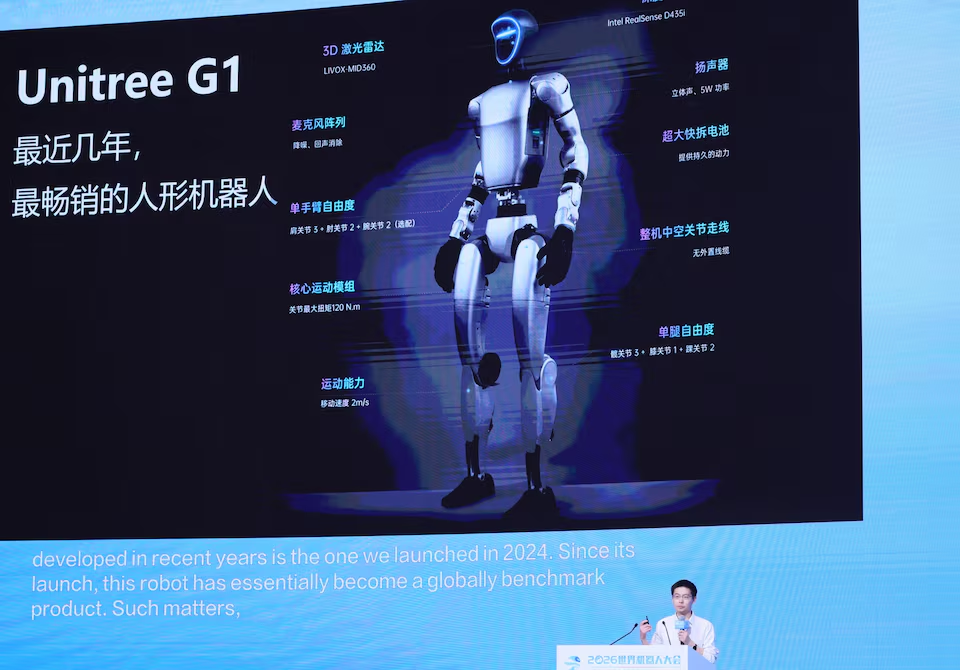
Humanoid robots could soon experience a breakthrough similar to the emergence of ChatGPT, according to Wang Xingxing, founder and chief executive of Chinese robotics company Unitree.
According to Reuters, Wang made the prediction on Thursday at a major robotics conference in Beijing, saying advances in artificial intelligence could soon allow robots to operate effectively in unfamiliar environments.
“We are marching towards a ‘ChatGPT moment’ in embodied intelligence,” Wang said.
Robots could handle household tasks
The Unitree founder said one major milestone would be reached when humanoid robots can enter unfamiliar homes and complete most everyday tasks using simple voice or text instructions.
He said developers eventually hope robots will be able to successfully perform about 80 per cent of household tasks without extensive specialised programming.
Wang described such a breakthrough as an important tipping point that could trigger explosive growth across the robotics industry.
Software remains major challenge
Despite his optimism, Wang acknowledged that robot software remains behind the rapid advances seen in hardware.
He said a major breakthrough could arrive within two to three years under an optimistic scenario, although it could take between five and 10 years.
Decision-making and the ability to understand unfamiliar environments remain among the biggest challenges facing humanoid robots.
China dominates humanoid robot shipments
China has emerged as a major force in the global humanoid robotics industry.
Industry figures cited at the conference showed Chinese companies delivered more than 40,000 humanoid robots during the first half of 2026 and accounted for the overwhelming majority of global shipments.
Beijing has encouraged investment in robotics as China looks to address labour shortages and strengthen its position in the global artificial intelligence race.
Unitree is already one of the world’s largest producers of robotic dogs and humanoid machines, placing the company at the centre of China’s push into physical AI.