




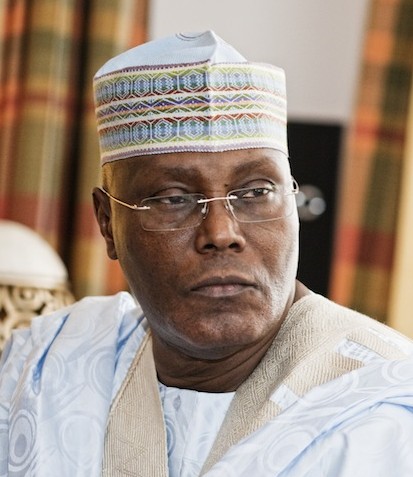
Former Vice President and African Democratic Congress presidential candidate, Atiku Abubakar, has accused President Bola Tinubu’s administration of stifling dissenting voices and relying on what he called “manipulated statistics” to downplay Nigeria’s economic challenges.
He also faulted the Presidency’s response to remarks made by former Catholic Archbishop of Abuja, Cardinal John Onaiyekan, on the nation’s condition, insisting that the government should apologise to the cleric and the Catholic Church.
In a statement released on Sunday through his Senior Special Assistant on Public Communication, Phrank Shaibu, Atiku criticised the government for allegedly attacking members of the Catholic Bishops’ Conference of Nigeria instead of addressing the concerns they raised about the country’s situation.
He said the administration had resorted to intimidation and character attacks against respected religious figures rather than engaging with the substance of their concerns.
“It was both unfortunate and dangerous that, instead of reflecting on the substance of the cleric’s message, the Presidency chose the familiar path of intimidation, ridicule and political attacks,” he said.
Atiku described the Catholic Church as a long-standing moral voice in Nigeria, noting that its leaders have consistently spoken out for the poor and vulnerable regardless of which government is in power.
“The Catholic Church has, for generations, stood as one of the moral voices of our nation.
“Its bishops and priests have consistently spoken for the poor, the oppressed and the vulnerable, irrespective of who occupies Aso Rock.
“Their duty is not to flatter those in power but to speak truth to power,” he stated.
He praised the Catholic bishops for raising concerns about Nigeria’s economic and political situation, calling their stance courageous and patriotic.
“The Catholic bishops demonstrated rare courage by looking the president in the face and telling him the bitter truth about the state of the nation.
“That is precisely what patriotic religious leaders are called to do, not to decorate power with praise, but to confront it with truth.
“We urge other religious leaders, regardless of denomination or faith, to emulate this example by speaking truth to power whenever the nation’s interest demands it,” he added.
Atiku also defended Cardinal Onaiyekan’s post-meeting comments with President Tinubu, saying the cleric was responding to what he described as attempts to control the narrative.
“Cardinal Onaiyekan’s decision to speak to the press after the Presidency sought to dominate and distort the public conversation was nothing more than an effort to place the facts on record.
“Such a responsible act cannot justify the vile, uncouth and disrespectful reaction that followed from Tinubu’s media handlers,” he said.
He further alleged that government officials tried to undermine the credibility of the bishops by selectively presenting details of their meeting with the President.
“What the media managers of the Tinubu administration attempted to do was to cancel and overwrite the voices of the revered Catholic bishops by selectively editing and reframing their engagement with the President to manufacture a narrative favourable to the government.
“That cynical exercise amounted to an affront to the integrity, credibility and moral authority of the bishops,” he stated.
The ADC candidate warned that democracy is threatened when independent voices are attacked for expressing dissenting views.
“The Presidency is not a secret cult where only approved voices are permitted to speak. In a constitutional democracy, no one needs the permission of Aso Rock to tell the truth about the state of the nation,” he noted.
He also criticised what he called the government’s attitude toward religious leaders, insisting that Catholic bishops cannot be used for political messaging.
“Perhaps the Presidency has become so accustomed to inviting ‘fake bishops’ that it now assumes every cleric can be recruited into political propaganda.
“But Catholic bishops are different. They are not political props, rented cheerleaders or praise singers. They are shepherds with a moral obligation to speak truth to power, regardless of whose interests are bruised. They cannot be used,” he declared.
Atiku argued that attacking critics would not change the realities of widespread hardship, insecurity, unemployment, and rising living costs in the country.
“The cleric merely gave voice to what millions of Nigerians discuss daily in their homes, markets, churches and workplaces.
“Silencing or attacking him will not erase the harsh realities of hunger, insecurity, rising poverty, unemployment and the unprecedented cost-of-living crisis confronting ordinary citizens,” he said.
He called on the Presidency to issue an apology to Cardinal Onaiyekan, the Catholic Church, and its members across the country.
“The Presidency owes the Catholic Church, Cardinal John Onaiyekan and the entire Catholic faithful an immediate and unreserved apology.
“The reckless assault on respected men of God was not merely an attack on individuals; it was an affront to one of Nigeria’s most credible moral institutions and an insult to millions of faithful Catholics.
“Until that apology is offered, the Tinubu administration will continue to stand accused of arrogance, intolerance and contempt for every independent voice that refuses to sing its praises,” he stated.
Beyond the controversy, Atiku also criticised the government’s economic management, arguing that official figures do not reflect the hardship experienced by citizens.
He accused the administration of relying on selective data presentation and “creative accounting” to project progress while living conditions deteriorate.
In a separate statement, he challenged claims by the Minister of Finance and Coordinating Minister of the Economy, Taiwo Oyedele, on the impact of reforms such as subsidy removal, debt restructuring, and welfare improvements.
He said claims that subsidy savings were used to reduce government debt were inconsistent with available records.
“As of May 2023, when President Tinubu assumed office, the Federal Government’s exposure to the Central Bank of Nigeria stood at approximately N26.9tn. Today, that exposure has ballooned to over N40.38tn.
“This administration has not reduced its indebtedness to the CBN. It has merely changed the label on the debt by converting Ways and Means advances into treasury bills and bonds while simultaneously piling up fresh obligations. That is debt restructuring, not debt repayment,” the statement read.
Atiku also questioned claims of improved workers’ welfare, saying key promises had not been fulfilled.
“Which salary increase is the government talking about? The Federal Government is yet to fully implement the new minimum wage. The 40 per cent peculiar allowance tied to the wage adjustment remains unpaid despite official directives that it should take effect from May 1, 2026.
“The promised wage award has equally not been fully implemented. These are not opposition allegations; they are the grievances of organised labour,” he added.
He further disputed claims about education funding, particularly the financing of the Nigerian Education Loan Fund.
“The Chief Executive Officer of NELFUND publicly stated that the scheme received a N50bn injection from recovered funds by the EFCC.
“If that is the case, why is the government now presenting subsidy savings as the source? Nigerians are tired of an administration that changes its story each time it is confronted with facts,” he said.
The former vice president also blamed rising interest rates on government borrowing, saying it has hurt businesses and the private sector.
“Who drove interest rates to their current levels? Under this administration, the Monetary Policy Rate has climbed dramatically, making borrowing prohibitively expensive for manufacturers and the private sector.
“Government’s insatiable appetite for borrowing has crowded out productive businesses while pushing debt servicing to unsustainable levels.
“To now blame interest rates is nothing short of an admission of policy failure,” he stated.
Atiku maintained that official economic indicators do not reflect the daily struggles of Nigerians.
“Food prices have spiralled beyond the reach of ordinary families. Inflation continues to erode incomes. Businesses are shutting down. Unemployment remains alarming.
“The naira has suffered unprecedented depreciation, while poverty has deepened across the country. These are the realities Nigerians confront daily, not the glossy presentations from government officials,” he said.
He argued that governments should be assessed based on citizens’ living conditions rather than official narratives.
“Governments are judged not by PowerPoint presentations or television interviews but by the quality of life of their citizens.
“On that score, this administration has failed spectacularly. Economic hardship cannot be explained away with clever rhetoric. Nigerians are living the consequences every day,” he added.
Atiku urged the Federal Government to prioritise transparency, accountability, and effective economic management.
The Tinubu administration, however, has consistently defended its reforms, saying they are necessary to stabilise public finances, attract investment, and build a sustainable economy. Critics, on the other hand, argue that the policies have worsened inflation, increased living costs, and reduced purchasing power nationwide.