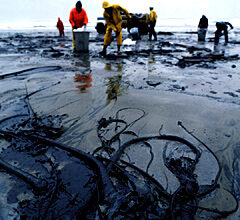





Some residents of Ogoniland in Rivers State have raised fresh concerns that oil pollution is still affecting their rivers, fish and farmlands, despite the ongoing clean-up by the Hydrocarbon Pollution Remediation Project.
The affected fisherfolk from Gbee, K-Dere and Nweemuu communities spoke on Wednesday at a multi-stakeholder dialogue held in Kpor, the headquarters of Gokana Local Government Area.
The dialogue, themed Restoring Rivers, Reviving Livelihoods, Renewing Lives, brought together representatives of fishing communities, HYPREP officials, the University of Port Harcourt, civil society groups, the Nigeria Oil Spill Detection and Response Agency, youths and women groups.
Some community leaders, including Chief Nadabel John, Chief Emmanuel Pii and Madam Grace Namon, said their sources of livelihood remain unsafe.
They said, “Our fish and periwinkles still have the smell of crude oil when we catch and cook them for consumption.”
They also expressed worry that their farmlands, vegetation and water bodies are still polluted, years after clean-up activities began.
Speaking at the event, the convener of the dialogue, Anuoluwapo Adelakun of the Pulitzer Centre for Crisis Reporting, said the meeting was organised due to findings from investigations and complaints from residents, which revealed a gap between HYPREP’s reports and what communities are experiencing.
Adelakun said a study carried out in partnership with the University of Port Harcourt showed that water sediments in some Ogoni communities still contain heavy metals, including nickel, which is known to cause cancer.
She said, “We came to Ogoniland to do very interesting studies on pollution, remediation and livelihoods. This project focused on rivers, wetlands, water bodies and aquatic life, and how people depend on them.”
She added, “We took samples from Bodo, K-Dere, Gbee and Mogho because people are still using the water and eating the fish.”
According to her, tests revealed high levels of heavy metals and petroleum hydrocarbons in fish and periwinkles.
“What we discovered is that people who are eating the fish and periwinkles are likely to fall very ill in the long run, especially children,” Adelakun said.
She noted that although HYPREP has reported about 70 per cent mangrove restoration and roughly 20 per cent shoreline clean-up, many families still depend daily on seafood that may be contaminated.
“Independent research conducted with the University of Port Harcourt shows that children eating fish in many parts of Ogoni face a high cancer risk, among other things,” she added.
Responding to the concerns, the Technical Assistant to the HYPREP Project Coordinator on Shoreline Clean-up, Peter Lenu, disputed claims that periwinkles could survive in heavily polluted areas.
He said, “Scientifically, you can’t find periwinkles alive in fresh hydrocarbon. That is an area where we need to put the record straight.”
Lenu explained that the Ogoni clean-up is a long-term process expected to last between 25 and 30 years, as stated in the United Nations Environment Programme report.
Addressing findings that showed Total Petroleum Hydrocarbon levels of about 277.5 milligrams per kilogram in one location, he argued that the result indicated major progress.
“When you consider that the baseline contamination was over 20,000 milligrams per kilogram, getting 277.5 means about 98 per cent success. Something significant has been done, but it is a process,” he said.
Lenu added that HYPREP is using an Enhanced Natural Attenuation method, which requires time to fully restore the environment.
He disclosed that second-phase shoreline clean-up contracts have been awarded in five communities where concerns were raised and would begin before the end of the first quarter of 2026.
He also said that Nweemuu is mainly a farming community and that pollution there could also come from fertilisers and pesticides washed into rivers by rainfall.
Lenu further revealed that HYPREP, in partnership with the World Health Organisation, is conducting a health study to assess the long-term effects of oil pollution on the Ogoni people.
“The shoreline clean-up is in phases. In Bodo, some areas were covered under the Renaissance clean-up project, while others will be addressed later by HYPREP,” he said.
He added that in Gbee community, second-phase clean-up has been approved and mangrove planting would continue in areas already certified clean.
“For the first phase of mangrove planting in Bomu, over 1.5 million seedlings have been planted across 560 hectares, and they are doing well,” Lenu said.